
This toolkit was created for the Stay Covered Coalition. Learn more about the Coalition here.
2026
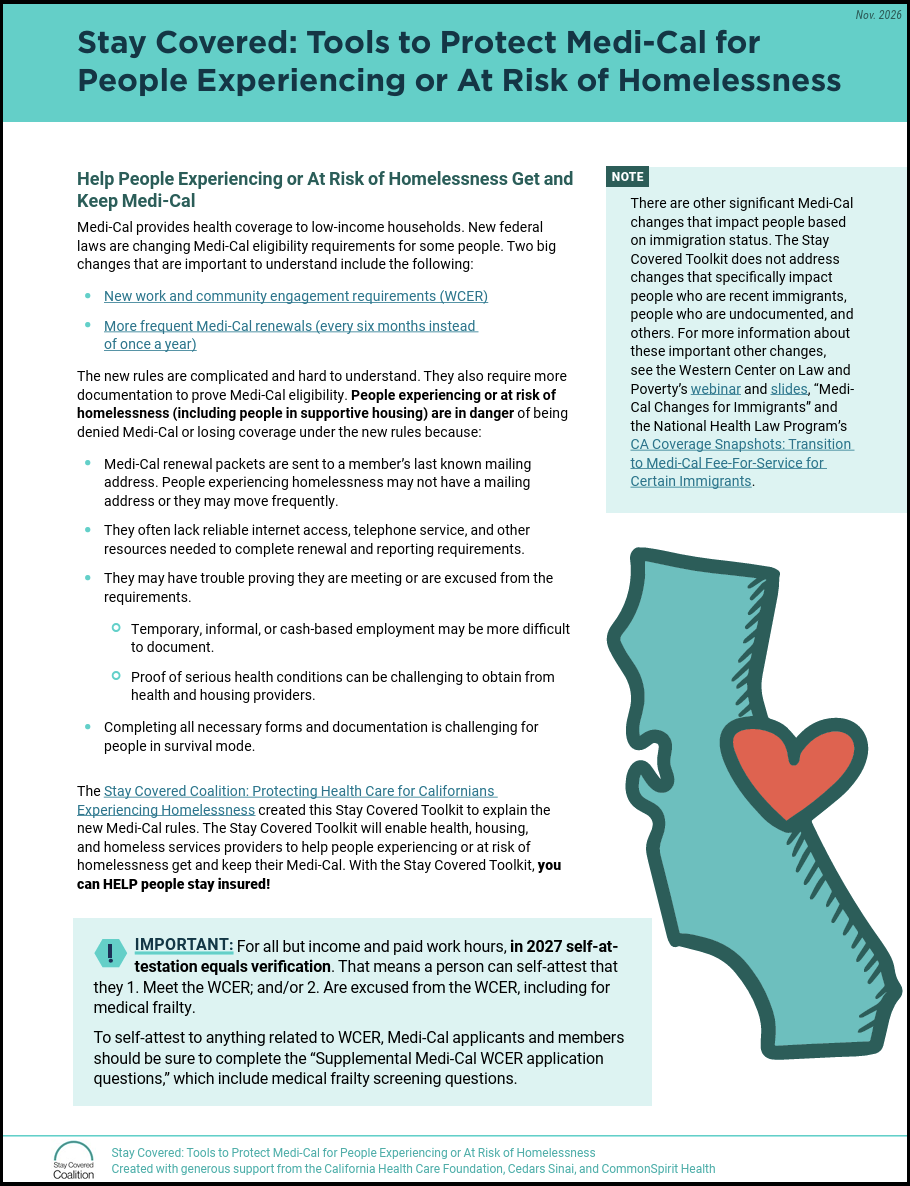
The Stay Covered Toolkit will enable health, housing, and homeless services providers to help people experiencing or at risk of homelessness get and keep their Medi-Cal. It includes an overview of the new H.R.1 rules and how it will impact Medi-Cal coverage for people experiencing homelessness; tools for health, housing, and homeless services providers to use when interacting with their clients and patients; and actions that different types of providers can take to help unhoused members stay covered.
Part 1: The Complicated Basics. What Medi-Cal is, what’s changing, who must meet the new work requirements and who could be excused, how medical frailty works under the new rules, and how applications and renewals work.
Part 2: Deep Dives. Practical guidance for supporting individual clients. Learn how to help a client be excused from or meet the requirements, respond if a client falls out of compliance, and connect clients to work, community service, job training, and education.
Part 3: How to Help. Specific mitigation strategies for health, housing, and homeless service providers and systems; managed care plans; recuperative care providers; health centers; street medicine providers; and hospitals. It also covers how to help people with disabilities get Medi-Cal through SSI/SSDI or other disability programs.
Fact Sheets
The Stay Covered Coalition has stand-alone fact sheets that provide a much deeper dive into some of the topics raised in the Toolkit and strategies that particular types of providers can take to mitigate coverage loss. These are linked below.
This Toolkit was created with generous support from the California Health Care Foundation, Cedars Sinai, and CommonSpirit Health. It was created by the Stay Covered Coalition partners, the California Street Medicine Collaborative (CSMC), Corporation for Supportive Housing (CSH), Homebase, Klurfeld Consulting, and the National Health Care for the Homeless Council (NHCHC), with contributions from the Coalition’s implementation partner, the Center for Health Care Strategies.
For more information about the Stay Covered Coalition, visit staycoveredcoalition.org.
