

Self-Pay as a Permanent Housing Solution: Guidance for Agencies Helping Medi-Cal Members Request Transitional Rent
This resource is for individuals and agencies working to help Medi-Cal Members complete Housing Support Plans (HSPs) in support of Transitional Rent (TR) referrals, specifically when the payment source for the Member’s post-TR permanent housing solution is self-pay. It outlines what to include in HSPs to help managed care plans (MCPs) understand a Member’s ability to self-pay as a way to sustain their housing following receipt of TR.
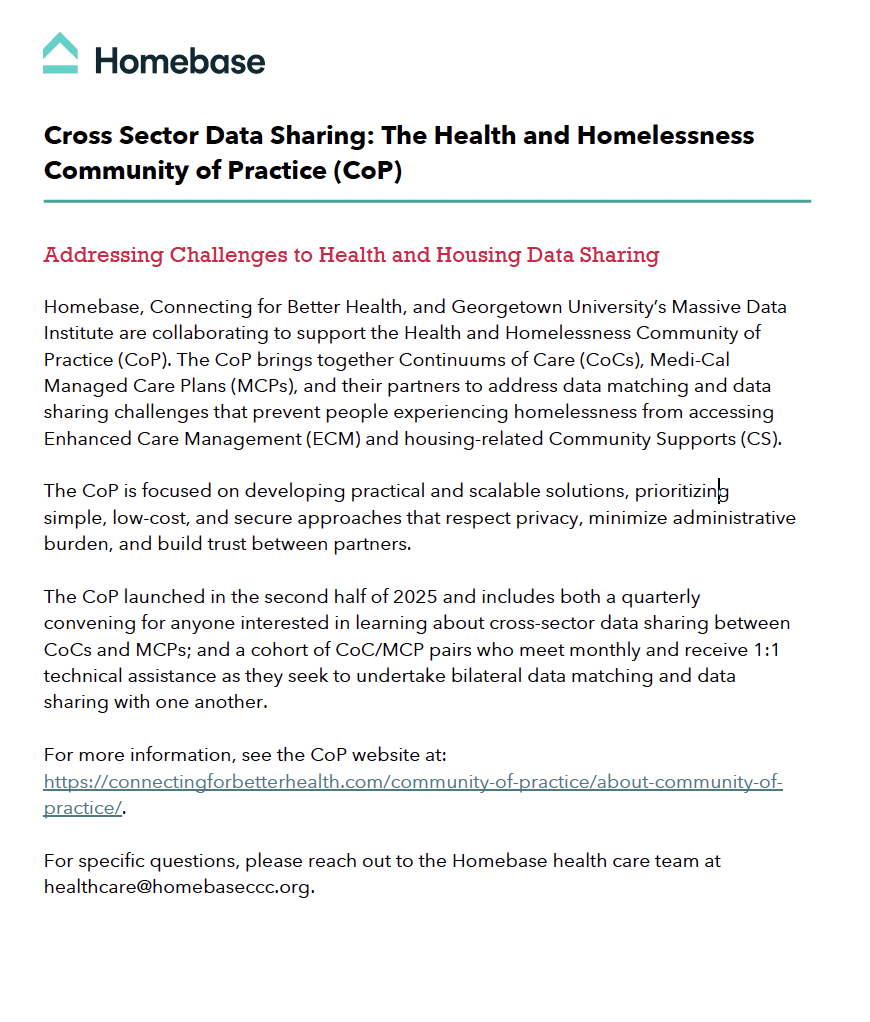
Health and Homelessness Data Sharing Community of Practice
Connecting for Better Health, Homebase, and Georgetown University’s Massive Data Institute have developed the Health and Homelessness Community of Practice (CoP). The CoP brings together Continuums of Care (CoCs), Medi-Cal Managed Care Plans (MCPs), and their partners to address data matching and sharing challenges that prevent people experiencing homelessness from accessing Enhanced Care Management (ECM) and housing-related Community Supports (CS).
Overview of Centers for Medicare & Medicaid Services (CMS) Guidance and Implications
This presentation outlines major Medicaid changes resulting from recently released CMS guidance related to H.R.1, including new work requirements and more frequent eligibility renewals. It also highlights the unique impacts these changes may have on people experiencing homelessness and the homeless response systems that support them.
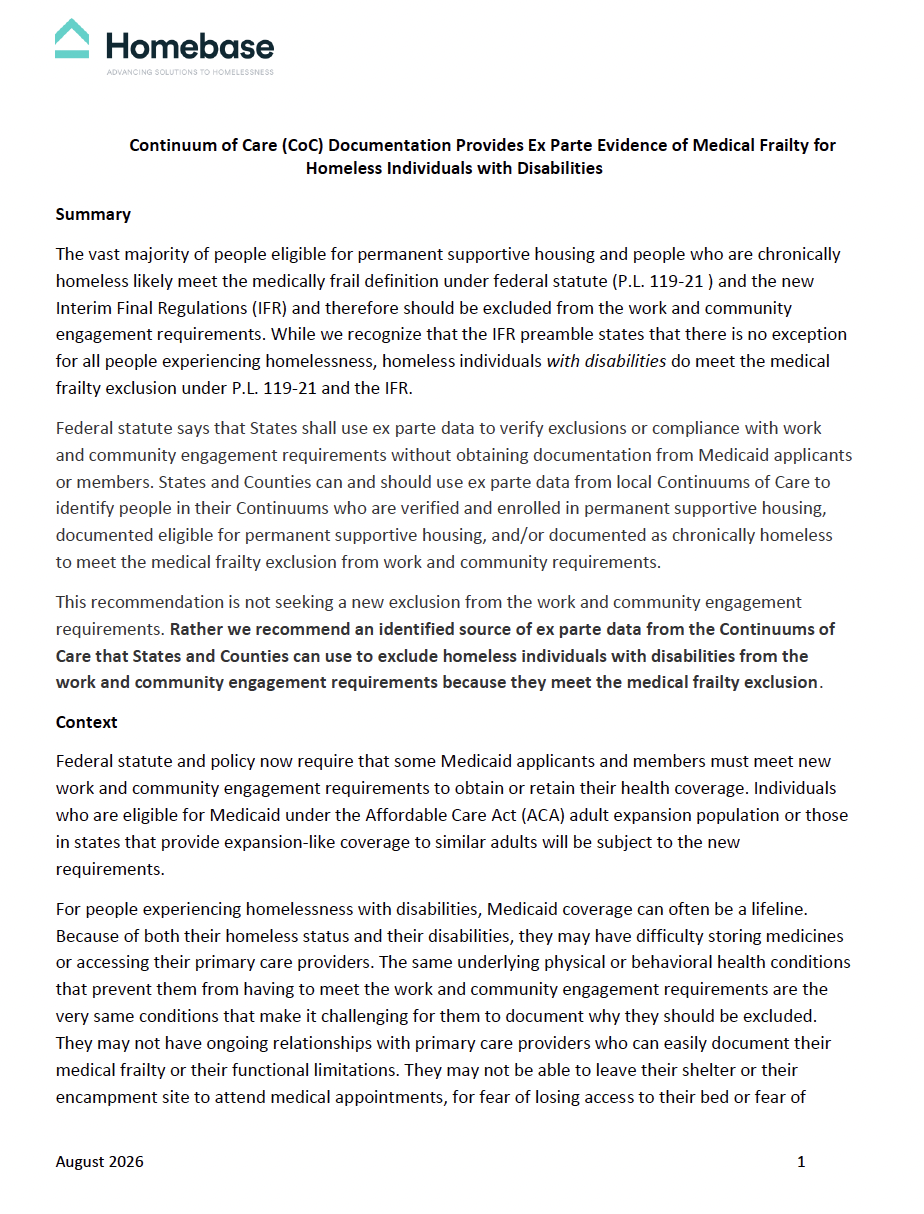
Continuum of Care (CoC) Documentation Provides Ex Parte Evidence of Medical Frailty for Homeless Individuals with Disabilities
Federal statute says that States shall use ex parte data to verify exclusions or compliance with work and community engagement requirements without obtaining documentation from Medicaid applicants or members. States and counties can and should use ex parte data from local Continuums of Care to identify people in their Continuums who are verified and enrolled in permanent supportive housing, documented eligible for permanent supportive housing, and/or documented as chronically homeless to meet the medical frailty exclusion from work and community requirements.
This recommendation is not seeking a new exclusion from the work and community engagement requirements. Rather we recommend an identified source of ex parte data from the Continuums of Care that States and Counties can use to exclude homeless individuals with disabilities from the work and community engagement requirements because they meet the medical frailty exclusion.
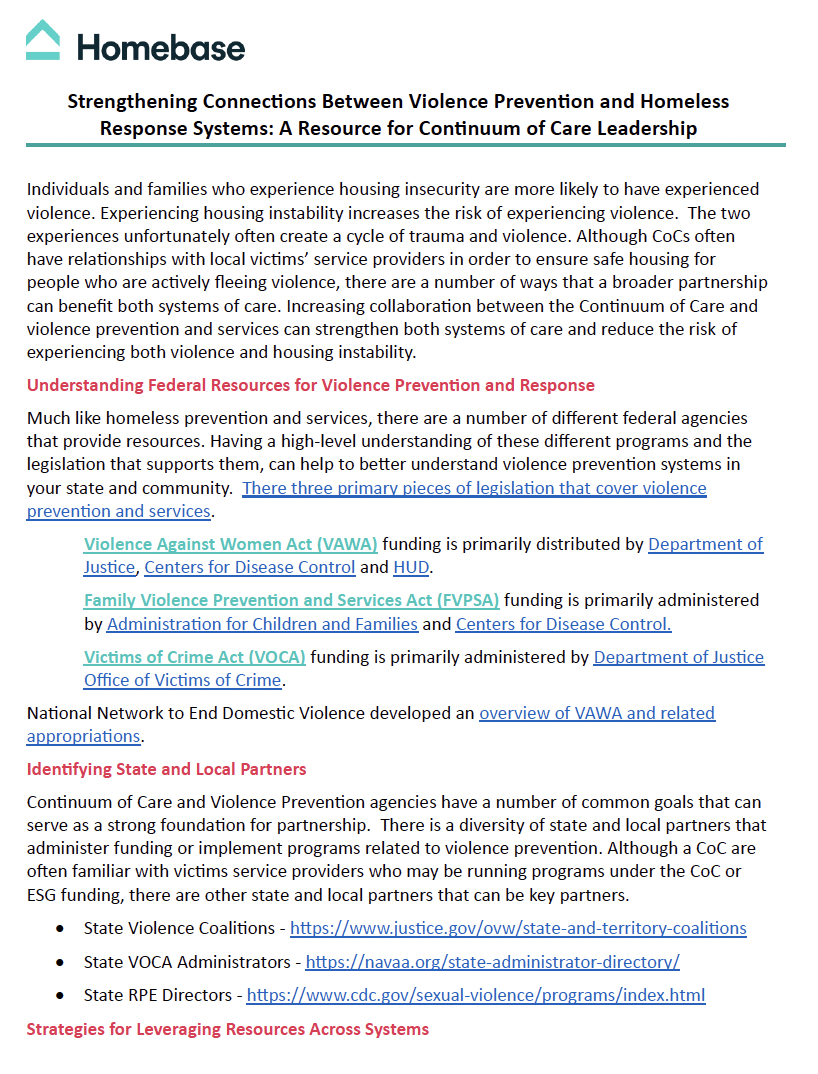
Strengthening Connections Between Violence Prevention and Homeless Response Systems: A Resource for Continuum of Care Leaders
Individuals and families who experience housing insecurity are more likely to have experienced violence, and experiencing housing instability increases the risk of experiencing violence. The two experiences can create a cycle of trauma and violence. Although CoCs often have relationships with local victims’ service providers to ensure safe housing for people who are actively fleeing violence, there are a number of ways that a broader partnership can benefit both systems of care. This resource pulls together guidance and tips for strengthening those partnerships.

Recommendations for Provider Assignments: Improving ECM & Community Supports Implementation
Good matches between Medi-Cal members experiencing homelessness and Enhanced Care Management (ECM) and housing-related Community Supports providers are vital to ensure members are successfully engaged, enrolled, and utilizing these critical resources. This resource includes tips and data sources to help managed care plans match members experiencing homelessness to providers best positioned to support them. It covers initial provider assignments and provider switching.

Meeting People Where They Are: A Guide for ECM Providers Serving People Experiencing Homelessness
Meeting people where they are is a core principle of Enhanced Care Management (ECM), but delivering services in shelters, encampments, and other community settings requires thoughtful planning and support. This resource shares practical strategies to help any ECM provider engage people experiencing homelessness in the field, with considerations for how Medi-Cal Managed Care Plans can support.
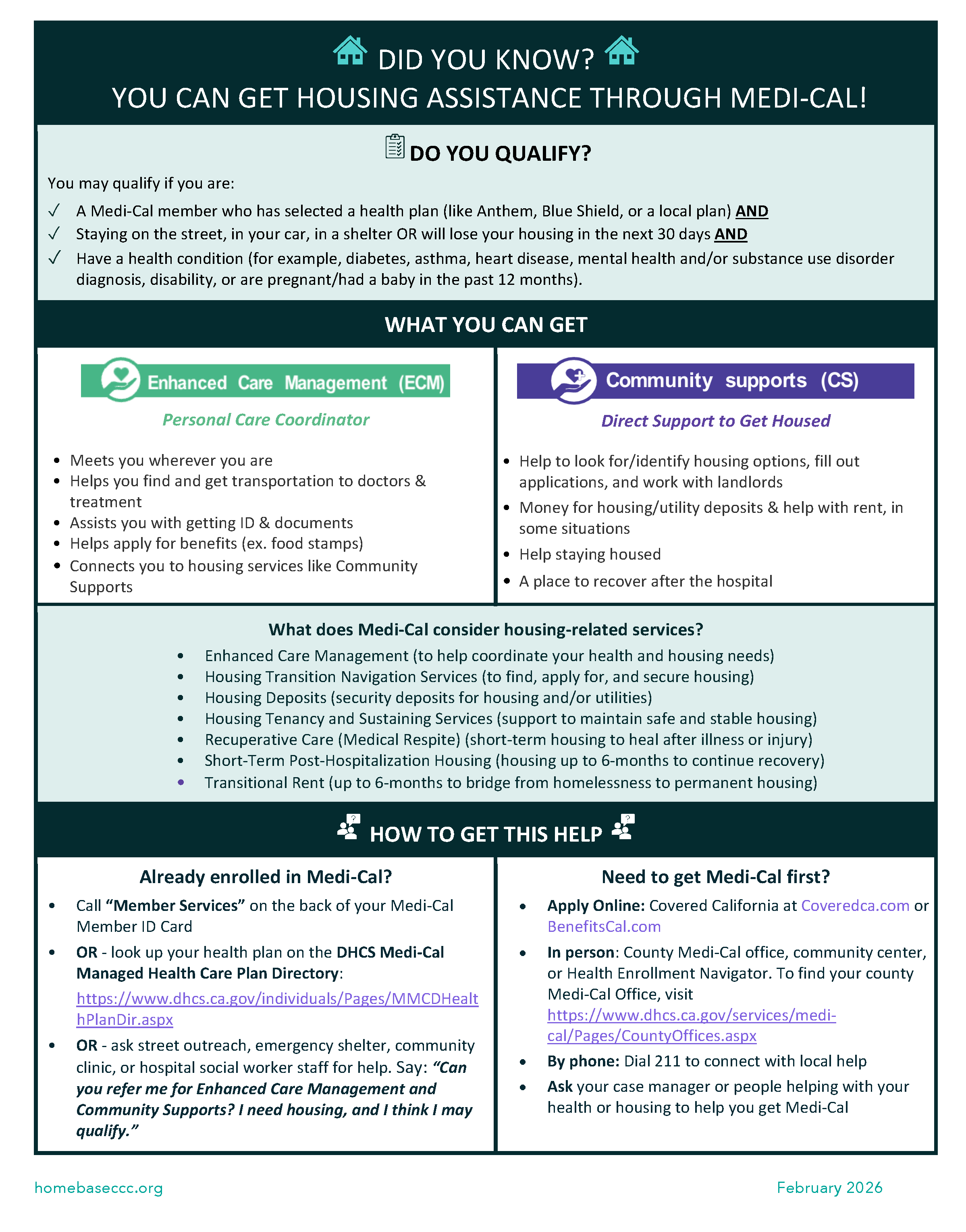
Member Flyer - How to Access Housing Assistance through Medi-Cal: CalAIM's ECM and Community Supports
A one-page flyer for Medi-Cal members experiencing homelessness on how to access housing assistance through Medi-Cal. Able to be distributed electronically or posted at places where Medi-Cal members experiencing homelessness may see it.
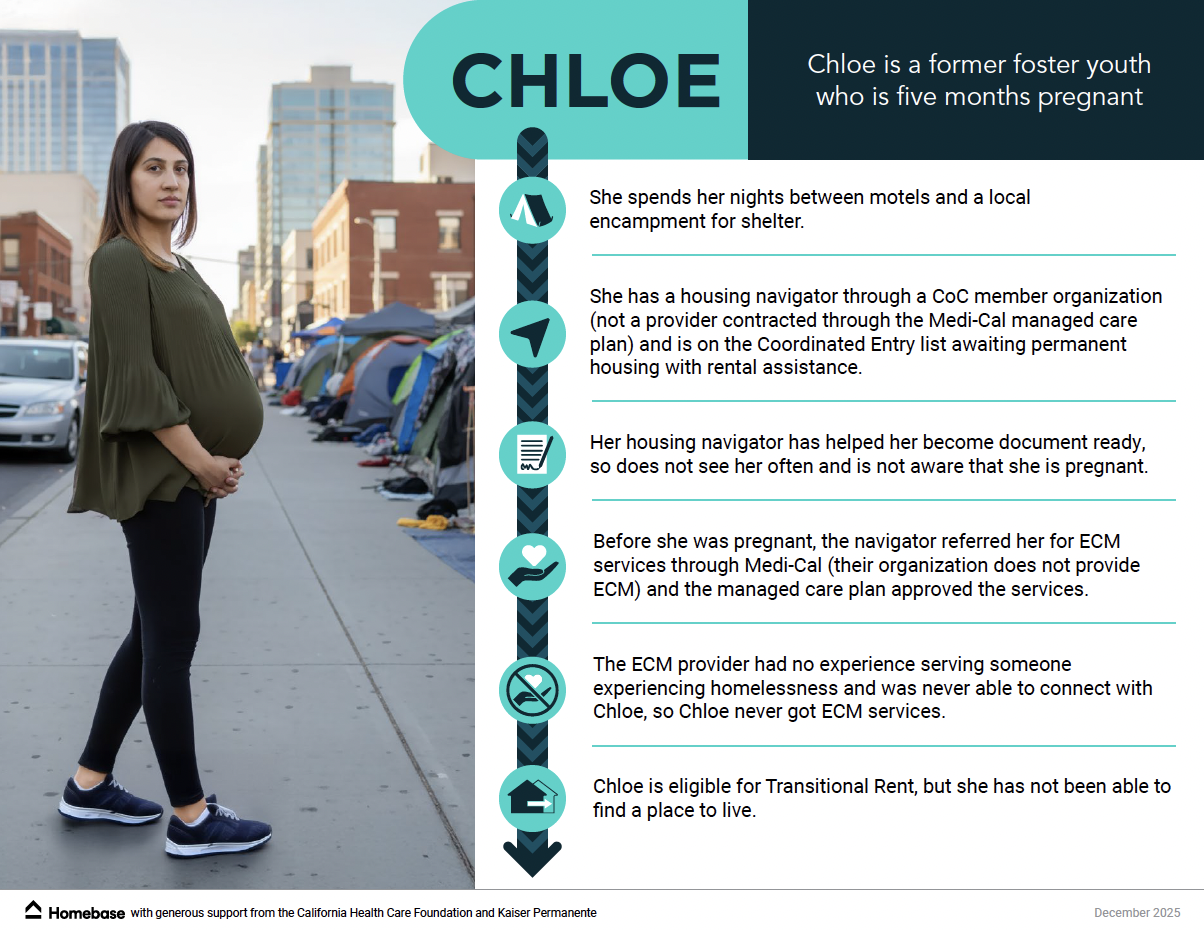
Medi-Cal Member Vignettes
These vignettes illustrate different types of people who may be eligible for Transitional Rent (TR). They are intended to ground TR discussions in the realities of people who may seek this new benefit.
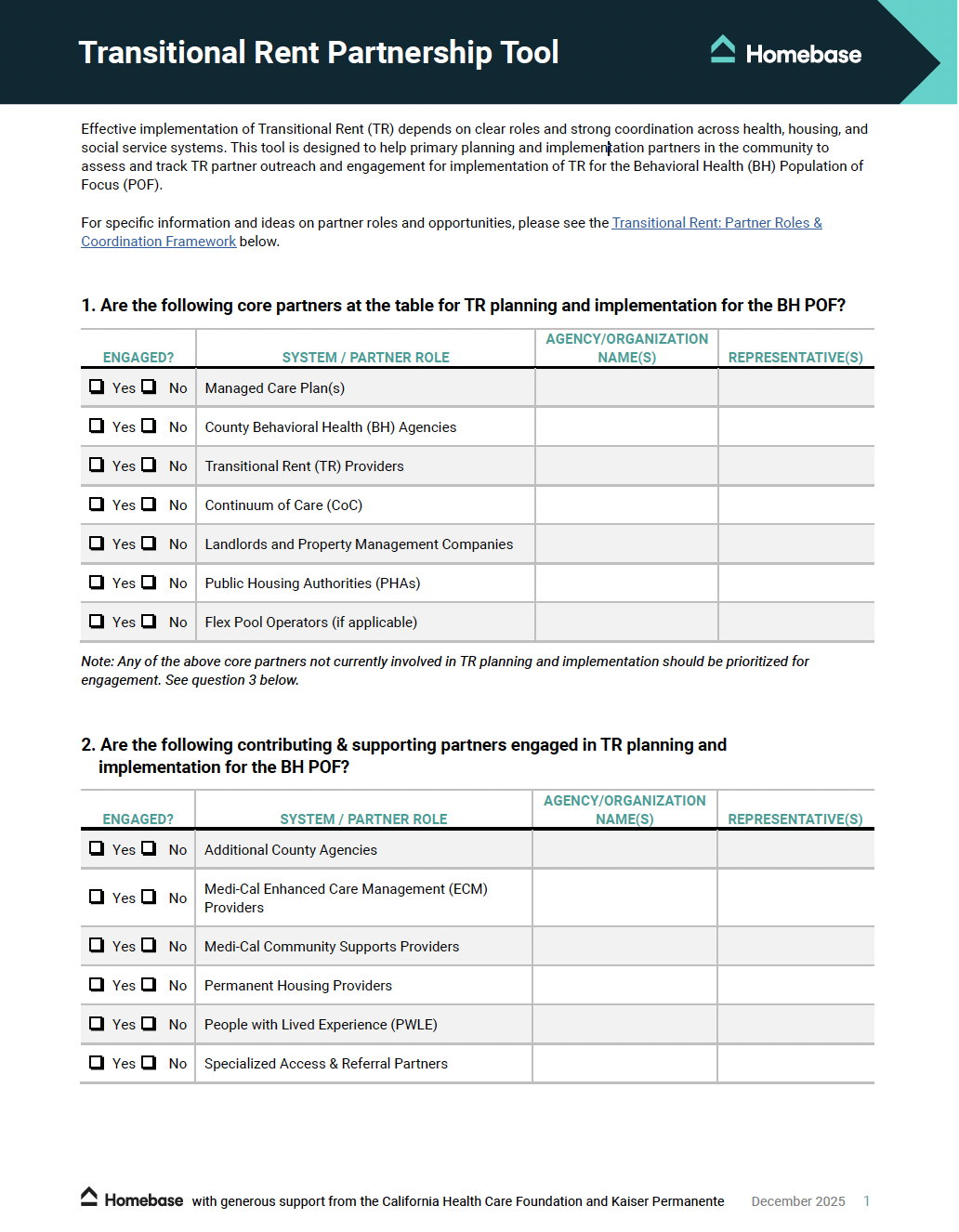
Transitional Rent Partnership Tool
Effective implementation of Transitional Rent (TR) depends on clear roles and strong coordination across health, housing, and social service systems. This tool is designed to help identify and engage TR partners in implementation efforts.

Housing Support Plan (HSP) Template for Transitional Rent and/or Housing Deposits
This document provides a template Housing Support Plan to assist with referrals for Transitional Rent, California's new Medicaid benefit that provides up to six months of rental assistance for eligible Medi-Cal members. Authorization for Transitional Rent requires a completed Housing Support Plan that meets specific criteria.
Community Partnerships and Resources to End Homelessness for all Populations - a Rural and Suburban CoC Perspective
With a focus on rural and suburban Continuums of Care (CoCs), this framework explores the idea of broadening community partnerships, responding to data, and expanding resource options to achieve an end to homelessness for multiple populations at once and sustain the achievements over time.
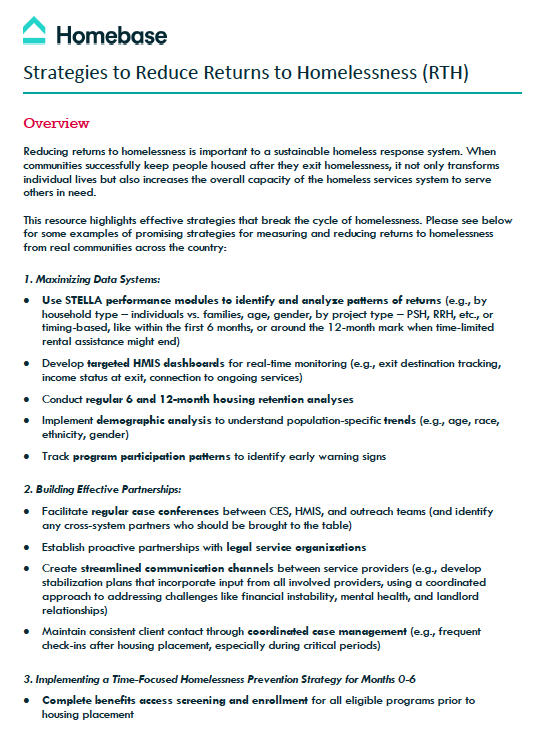
System Performance Measure Improvement Toolkit
These guides are designed to help communities, Continuums of Care (CoCs), and homeless service providers address and improve key aspects of the homelessness system of care. They provide evidence-based, practical approaches for increasing employment income, securing permanent housing, preventing first-time homelessness, reducing time spent homeless, and preventing returns to homelessness.
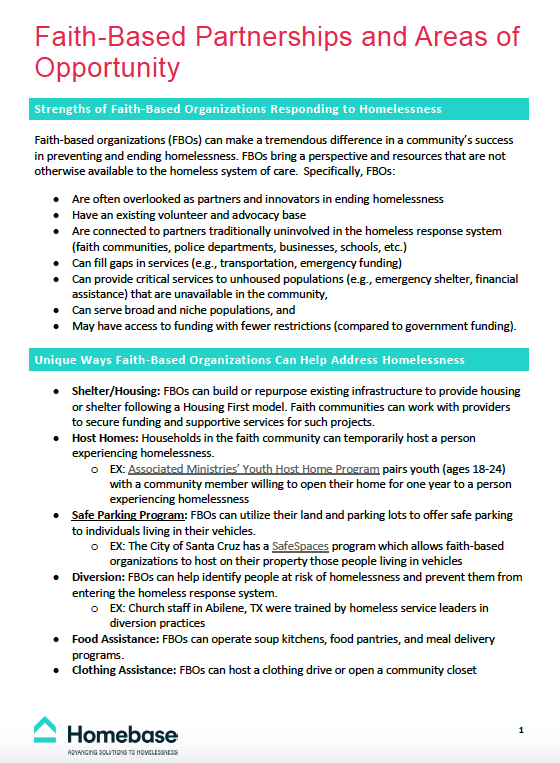
Faith-Based Community Partnerships and Areas of Opportunity
Faith-based organizations (FBOs) can make a tremendous difference in a community’s success in preventing and ending homelessness. FBOs bring a perspective and resources that are not otherwise available to the homeless system of care. This guide offers potential strengths of FBO partnerships, along with opportunities for FBOs to support homelessness response and strategies homeless systems can employ to support these partnerships.
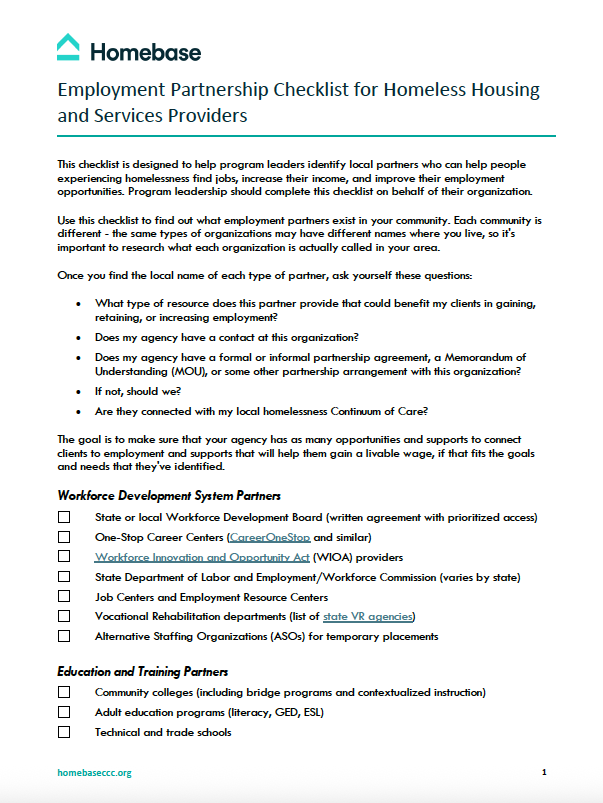
Employment Partnership Checklist for Homeless Housing and Services Providers
This checklist, to be completed by program leadership, is designed to help program leaders identify local partners who can help people experiencing homelessness find jobs, increase their income, and improve their employment opportunities.
Outreach to Faith-Based Organizations to Address Homelessness
This toolkit supports leaders of homeless systems of care to connect with representatives of faith-based organizations through new and expanded partnerships.
Serving People Involved with the Criminal Justice System in Rural Communities
People returning home to rural areas from incarceration face unique challenges. Transportation issues, limited services options, stigma, and a lack of affordable housing can make it challenging for those reentering the community to find a safe and stable place to live. This tool outlines strategies that rural communities can undertake to meaningfully address homelessness for individuals involved with the criminal justice system.
Recruiting and Retaining an Effective Behavioral Health Workforce to Support People Experiencing Homelessness
Recruiting and retaining an effective behavioral health workforce ensures consistent quality care for people experiencing mental health concerns, people living with substance use disorders, and people experiencing homelessness. This toolkit addresses recruitment and support for people with lived experiences, preventing and addressing staff turnover, and operationalizing recruitment and retention of an effective workforce.
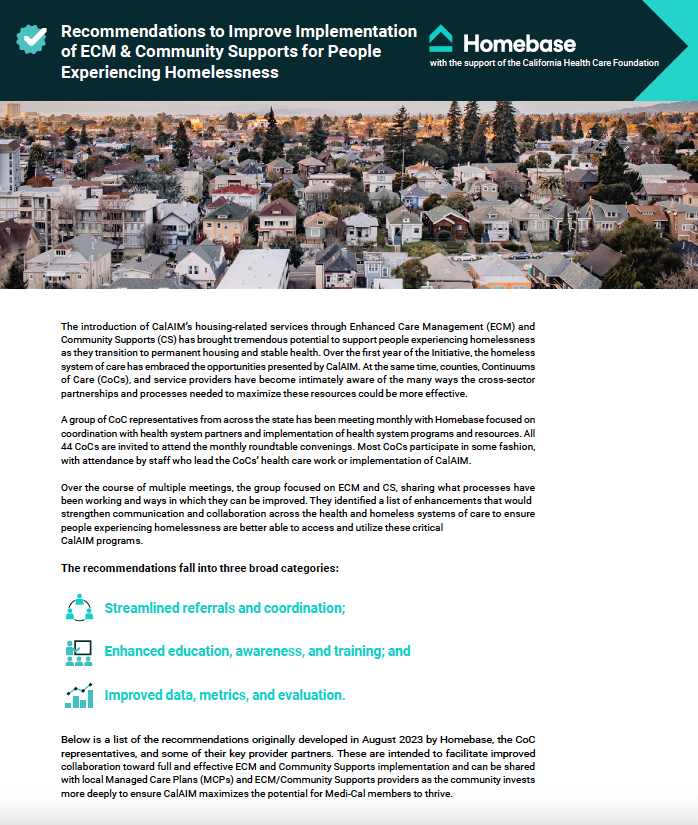
Recommendations to Improve Implementation of ECM and Community Supports for People Experiencing Homelessness
This section of the CalAIM Toolkit for Continuums of Care (CoCs) and CoC Partners offers a list of the recommendations developed by Homebase, California CoC representatives, and some key provider partners. These are intended to facilitate improved collaboration toward full and effective ECM and Community Supports implementation.
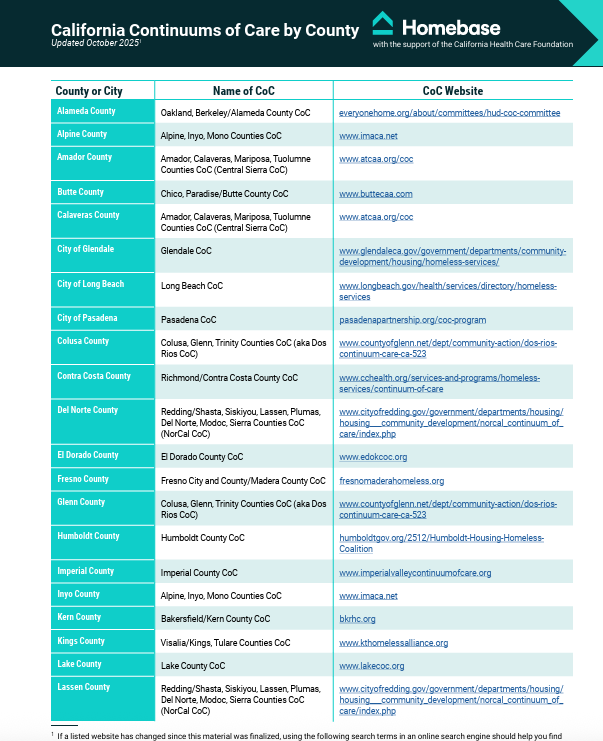
California Continuums of Care by County
This section of the CalAIM Toolkit for Continuums of Care (CoCs) and CoC Partners provides a reference list of California’s CoCs by county.