

CalAIM's Housing Related Services: Enhanced Care Management and Community Supports for Local Health Jurisdictions
This training provides an overview of CalAIM's housing-related supports so that public health departments can understand and leverage these new resources for the individuals they serve.

Serving People Experiencing Homelessness: Best Practices from Departments of Public Health
This webinar features local California public health departments that are addressing homelessness in their communities through new and innovative ways.
Serving People Experiencing Homelessness: Best Practices for Collaborating with Homeless Systems of Care
This training for local health jurisdictions and public health departments provides an overview of the foundations of the homeless system, so local public health departments can better understand and collaborate with the homeless system of care.
Introduction to Homelessness Response and Coordinated Entry
This training provides an overview of the foundations of the homeless system, so health care partners can better understand and collaborate with the homeless system of care.
Health Care Sector Participation in Coordinated Entry
This training shares opportunities for the health care sector to participate in Coordinated Entry.
Sharing Data Across Health and Homeless Systems of Care
This webinar provides an overview of the importance of data sharing between the health and homelessness sectors. It includes presentations from California communities driving innovations in cross-sector data sharing.
Hospital Discharge: Connecting Patients to Homeless Systems of Care
This training provides insight into opportunities to prevent hospital discharges into homelessness.

Implementation of the Housing & Homelessness Incentive Program (HHIP) & New HHIP Implementation
This webinar provides a deep dive into California's Housing & Homelessness Incentive Program (HHIP) and introduces Homebase's new HHIP Toolkit.
Overview of CalAIM & HHIP for CoCs
This webinar provides an overview of CalAIM and HHIP for CA's Continuums of Care (CoCs) and ways to leverage the funding streams and partnerships to strengthen health and housing outcomes.
Collaborating with Health System Partners: Why, Who, and How?
This training provides an overview of the health system and benefits of cross-sector collaboration, to support efforts to engage health care partners in homeless response efforts.
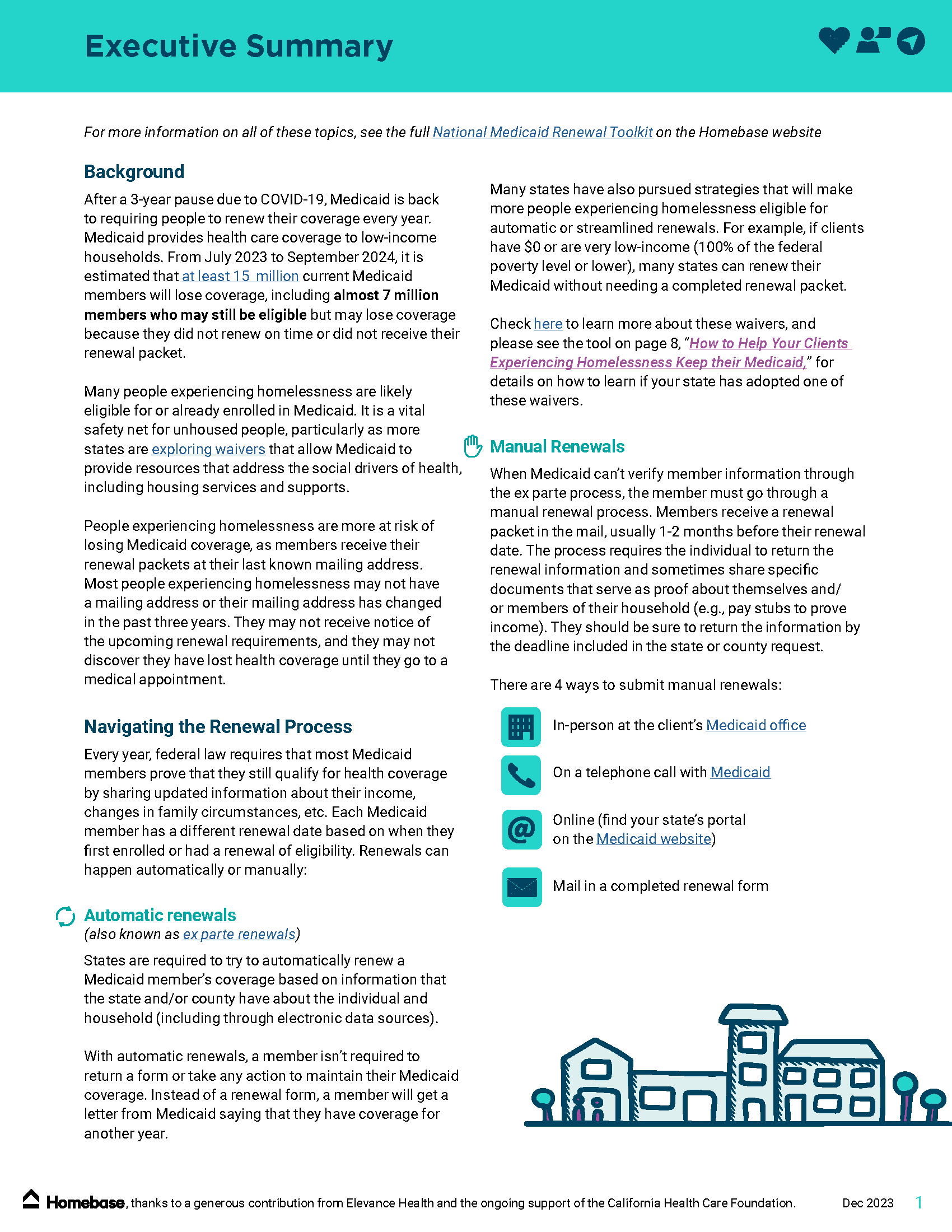
National Medicaid Renewal Toolkits
Check out our different National Medicaid Renewal Toolkits to learn how to help people experiencing homelessness renew their Medicaid.

Homelessness Response System 101 for Health Care Providers and Stakeholders
The report contains foundational information for health care providers about how homeless assistance works at the local level, with a focus on Continuums of Care (CoCs) and Coordinated Entry (CE). The report includes practical, action-oriented suggestions on how to participate in a local community's homelessness response.
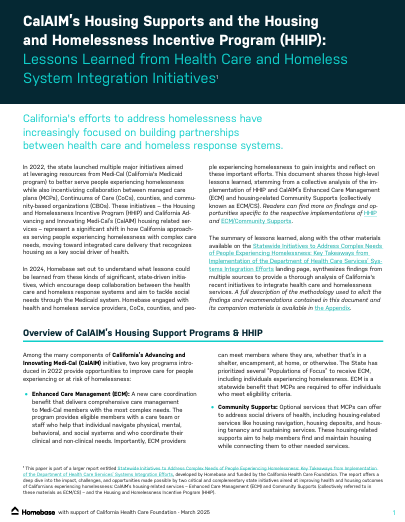
California Statewide Initiatives to Address Complex Needs of People Experiencing Homelessness
This suite of reports offers a deep dive into the impact, challenges, and opportunities made possible by two critical and complementary state initiatives aimed at improving health and housing outcomes of Californians experiencing homelessness: CalAIM’s housing-related services – Enhanced Care Management (ECM) and Community Supports (collectively referred to in these materials as ECM/CS) –and the Housing and Homelessness Incentive Program (HHIP).
Reflections on 10 Years of Health Care and Housing Integrations
This blog shares Senior Directing Attorney Gillian Morshedi's reflections on the integration of housing and health, and how the field has progressed over the past decade.

Transferring Knowledge: Improving Medicaid Access for People Experiencing Homelessness
When we set out to help homeless service providers navigate Medi-Cal renewals, we didn’t expect to uncover another systemic challenge faced by people experiencing homelessness: keeping Medi-Cal when moving across county lines. In this blog post, Policy Analyst, Riley Meve, and Senior Directing Attorney, Julie Silas, share how community conversations led to new collaborations and resources.
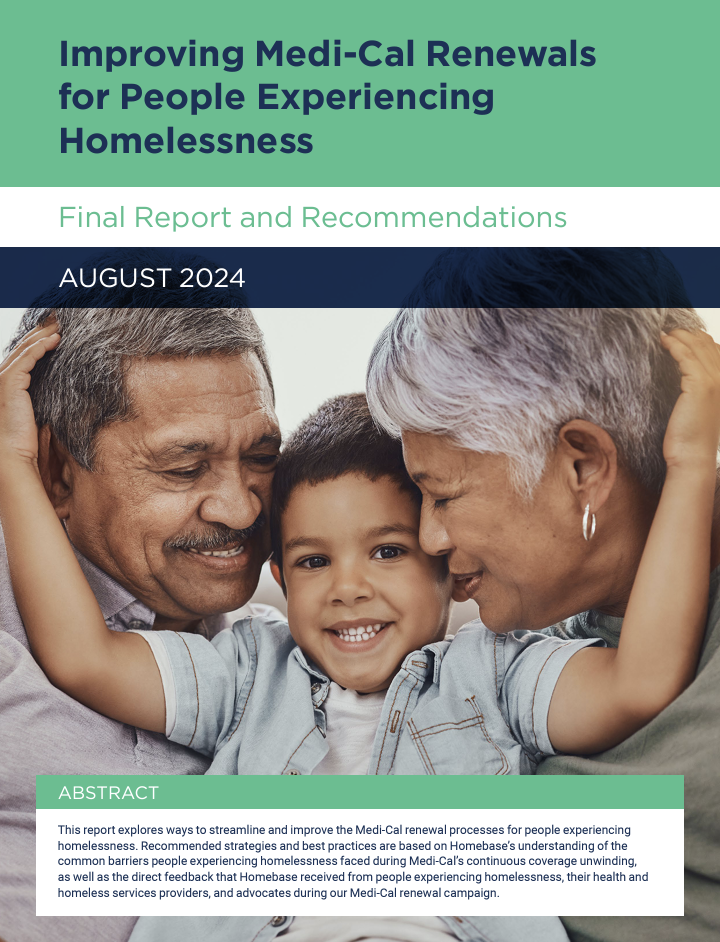
Improving Medi-Cal Renewals for People Experiencing Homelessness
This report explores ways to streamline and improve the Medi-Cal renewal processes for people experiencing homelessness, with recommended strategies and best practices based on Homebase’s understanding of the common barriers people experiencing homelessness faced during Medi-Cal’s continuous coverage unwinding, as well as the direct feedback that Homebase received from people experiencing homelessness, their health and homeless services providers, and advocates during our Medi-Cal renewal campaign.

Advancing Health Equity: Peer Health Ambassadors for People Experiencing Homelessness
Peer Health Ambassador Programs have been developed to improve health education and connections for people experiencing homelessness by hiring, training, and mentoring health ambassadors who have lived expertise and experiences of homelessness. This toolkit is designed to help new and expanded Peer Health Ambassador Programs design, develop, and implement their programs in ways that are effective, equitable, and specific to the needs of people experiencing homelessness in the community. This toolkit provides foundational information, best practice guidance, and sample resources that can support local design and implementation.
Medi-Cal Renewals: Ensuring People Experiencing Homelessness Retain Coverage
After a three-year pause due to COVID-19, the Medi-Cal renewal process restarted in California as of June 2023. This training highlights the risk of losing coverage during this process, especially for people who are unhoused. This training provides an introduction to Homebase's Medi-Cal Renwal Toolkit, which provides 11 tools for homelessness providers, people experiencing homelessness, and Health Enrollment Navigators to help people maintain their coverage.
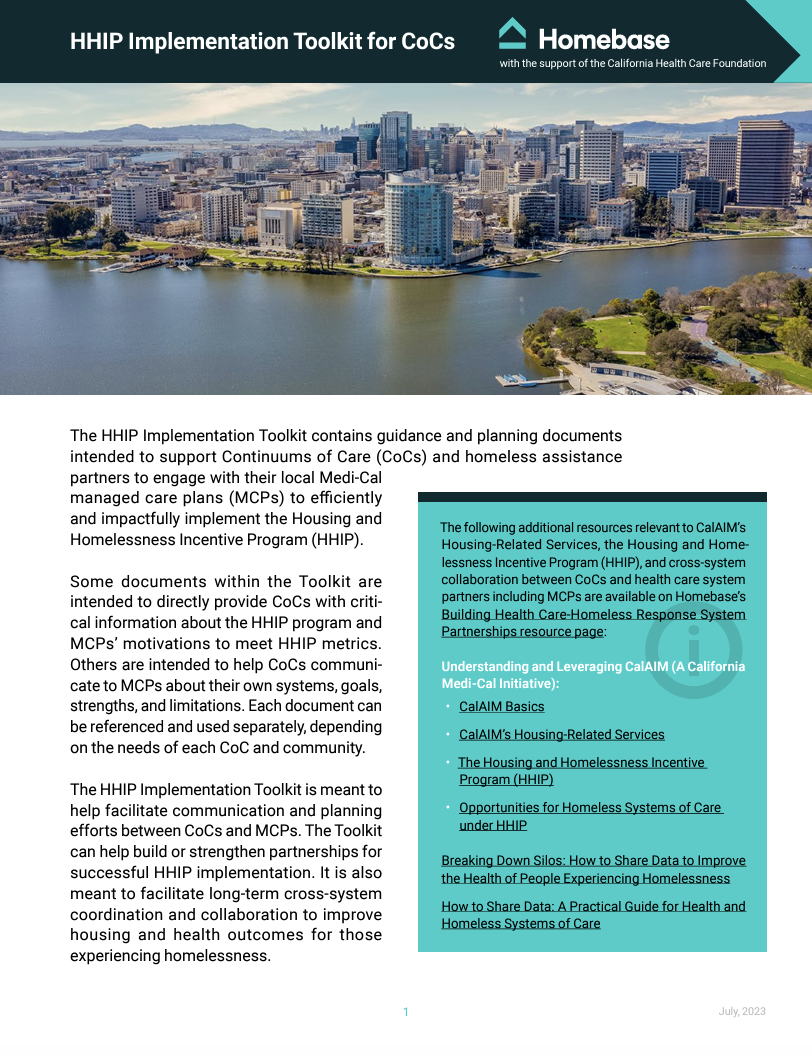
CalAIM Toolkit for Continuums of Care (CoCs) and CoC Partners
The CalAIM Toolkit for Continuums of Care (CoCs) and CoC partners contains guidance and planning documents intended to support effective cross-system collaboration between homeless response system partners and local Medi-Cal managed care plans (MCPs) through the California Advancing and Innovating Medi-Cal (CalAIM) initiative.
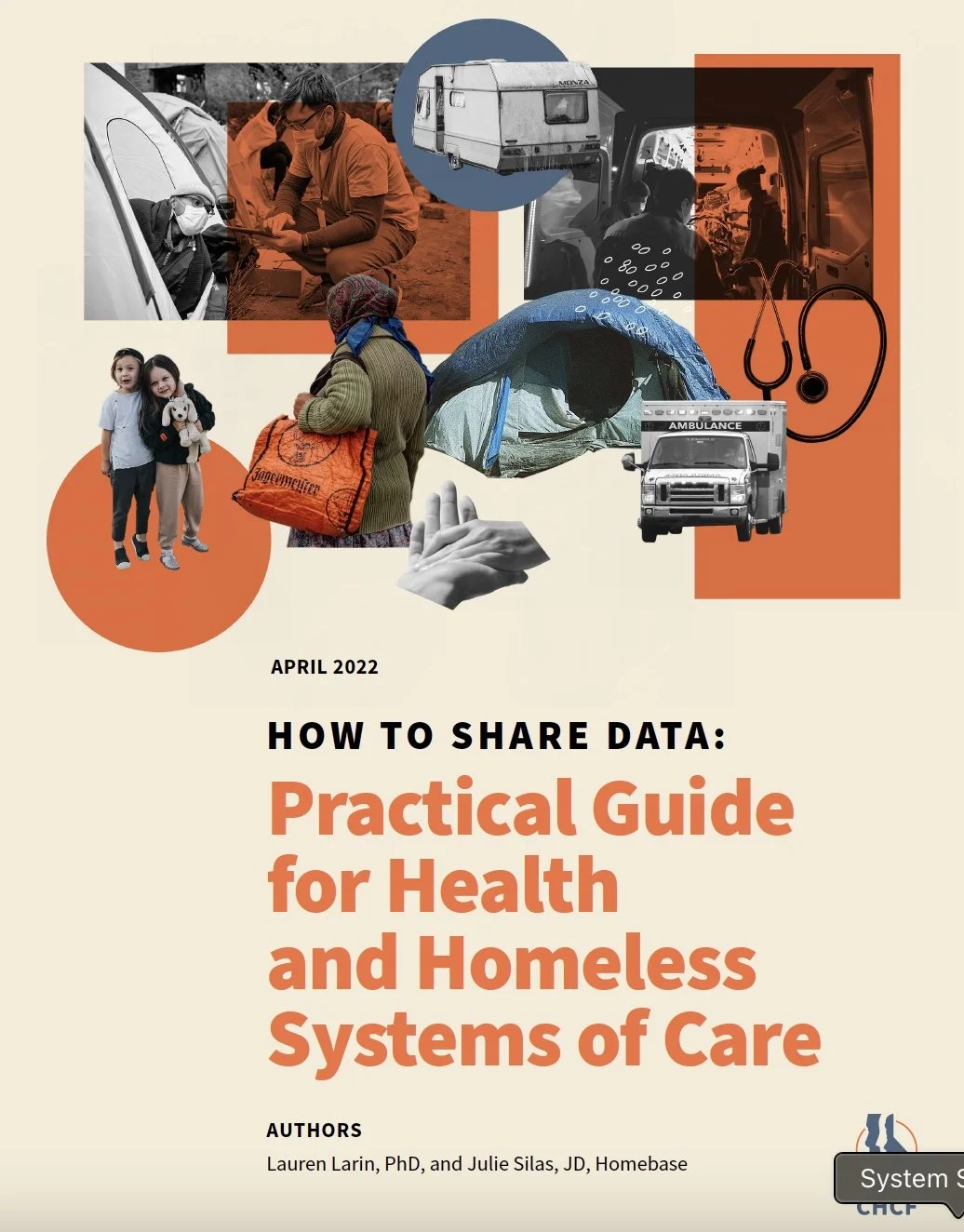
How to Share Data - Practical Guide for Health and Homelessness System of Care
This practical guide is intended to serve as a tool for communities at any stage of engagement in cross-sector data sharing between health and homeless systems of care. It is designed to help communities ready to start such efforts for the first time, as well as those that have room to grow their data sharing efforts.