
10 ways to help people experiencing homelessness keep their Medicaid
This interactive page gives health and housing providers a quick overview of upcoming Medicaid changes and practical steps you can take today. Acting now helps ensure unhoused clients maintain their health coverage and care without interruption.
State Letter about Upcoming Medi-Cal Changes: Help People Experiencing Homelessness Keep Medi-Cal Now
In September 2026, California’s Department of Health Care Services (DHCS) started sending out a four-page letter to Medi-Cal members. The letter went to Medi-Cal members who are part of the ACA Expansion Population (adults 19-64 years old, usually without children). The letter tells members about federal changes to Medi-Cal that go into effect beginning March 1, 2027. The changes include requiring renewals every six months, and requiring members to meet new work and community engagement requirements. Luckily, some members can be excused from the new rules.
Clients who got these letters may start asking questions. The letter may be their first time hearing about the changes to Medi-Cal, and they may need help understanding the new rules. They may need help to not lose Medi-Cal coverage. This document includes useful information for providers to help these clients navigate the changes and maintain coverage.
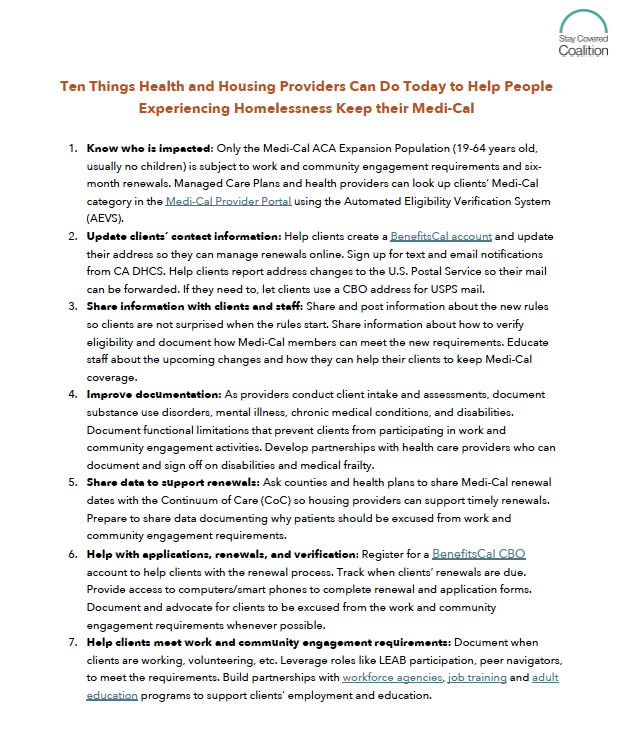
Ten Things Health and Housing Providers Can Do Today to Help People Experiencing Homelessness Keep their Medi-Cal
As 2025 H.R.1 changes put Medicaid coverage at risk, it’s important for health and housing providers to know what they can do to protect coverage for people experiencing homelessness. This document lays out the top ten things providers can do today.

Self-Pay as a Permanent Housing Solution: Guidance for Agencies Helping Medi-Cal Members Request Transitional Rent
This resource is for individuals and agencies working to help Medi-Cal Members complete Housing Support Plans (HSPs) in support of Transitional Rent (TR) referrals, specifically when the payment source for the Member’s post-TR permanent housing solution is self-pay. It outlines what to include in HSPs to help managed care plans (MCPs) understand a Member’s ability to self-pay as a way to sustain their housing following receipt of TR.
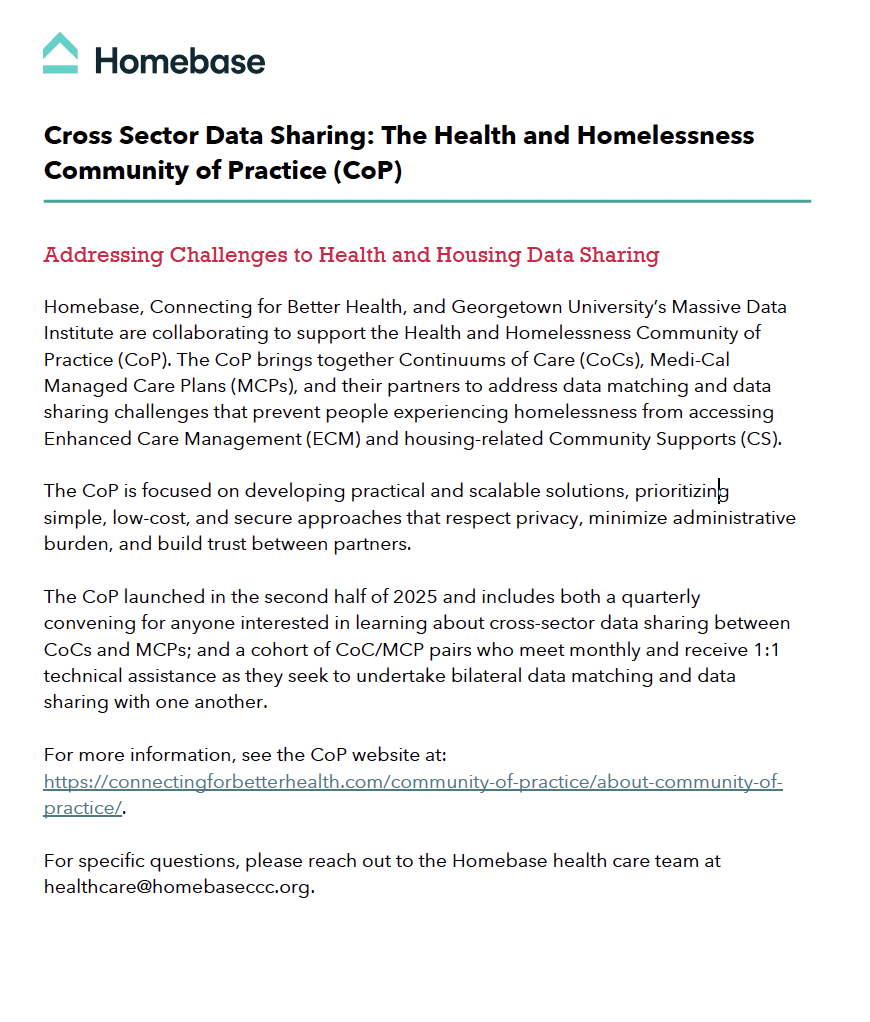
Health and Homelessness Data Sharing Community of Practice
Connecting for Better Health, Homebase, and Georgetown University’s Massive Data Institute have developed the Health and Homelessness Community of Practice (CoP). The CoP brings together Continuums of Care (CoCs), Medi-Cal Managed Care Plans (MCPs), and their partners to address data matching and sharing challenges that prevent people experiencing homelessness from accessing Enhanced Care Management (ECM) and housing-related Community Supports (CS).
Overview of Centers for Medicare & Medicaid Services (CMS) Guidance and Implications
This presentation outlines major Medicaid changes resulting from recently released CMS guidance related to H.R.1, including new work requirements and more frequent eligibility renewals. It also highlights the unique impacts these changes may have on people experiencing homelessness and the homeless response systems that support them.
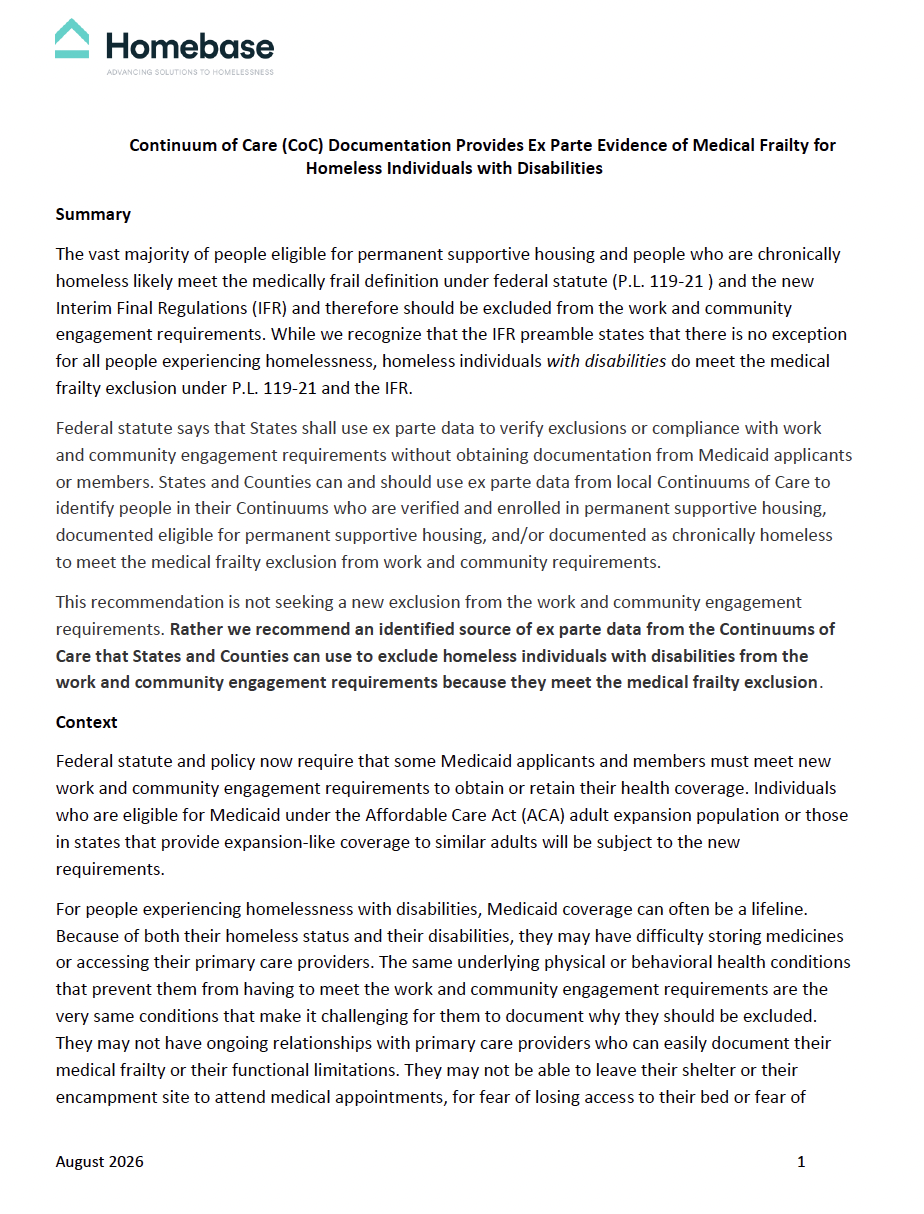
Continuum of Care (CoC) Documentation Provides Ex Parte Evidence of Medical Frailty for Homeless Individuals with Disabilities
Federal statute says that States shall use ex parte data to verify exclusions or compliance with work and community engagement requirements without obtaining documentation from Medicaid applicants or members. States and counties can and should use ex parte data from local Continuums of Care to identify people in their Continuums who are verified and enrolled in permanent supportive housing, documented eligible for permanent supportive housing, and/or documented as chronically homeless to meet the medical frailty exclusion from work and community requirements.
This recommendation is not seeking a new exclusion from the work and community engagement requirements. Rather we recommend an identified source of ex parte data from the Continuums of Care that States and Counties can use to exclude homeless individuals with disabilities from the work and community engagement requirements because they meet the medical frailty exclusion.

Recommendations for Provider Assignments: Improving ECM & Community Supports Implementation
Good matches between Medi-Cal members experiencing homelessness and Enhanced Care Management (ECM) and housing-related Community Supports providers are vital to ensure members are successfully engaged, enrolled, and utilizing these critical resources. This resource includes tips and data sources to help managed care plans match members experiencing homelessness to providers best positioned to support them. It covers initial provider assignments and provider switching.

Meeting People Where They Are: A Guide for ECM Providers Serving People Experiencing Homelessness
Meeting people where they are is a core principle of Enhanced Care Management (ECM), but delivering services in shelters, encampments, and other community settings requires thoughtful planning and support. This resource shares practical strategies to help any ECM provider engage people experiencing homelessness in the field, with considerations for how Medi-Cal Managed Care Plans can support.
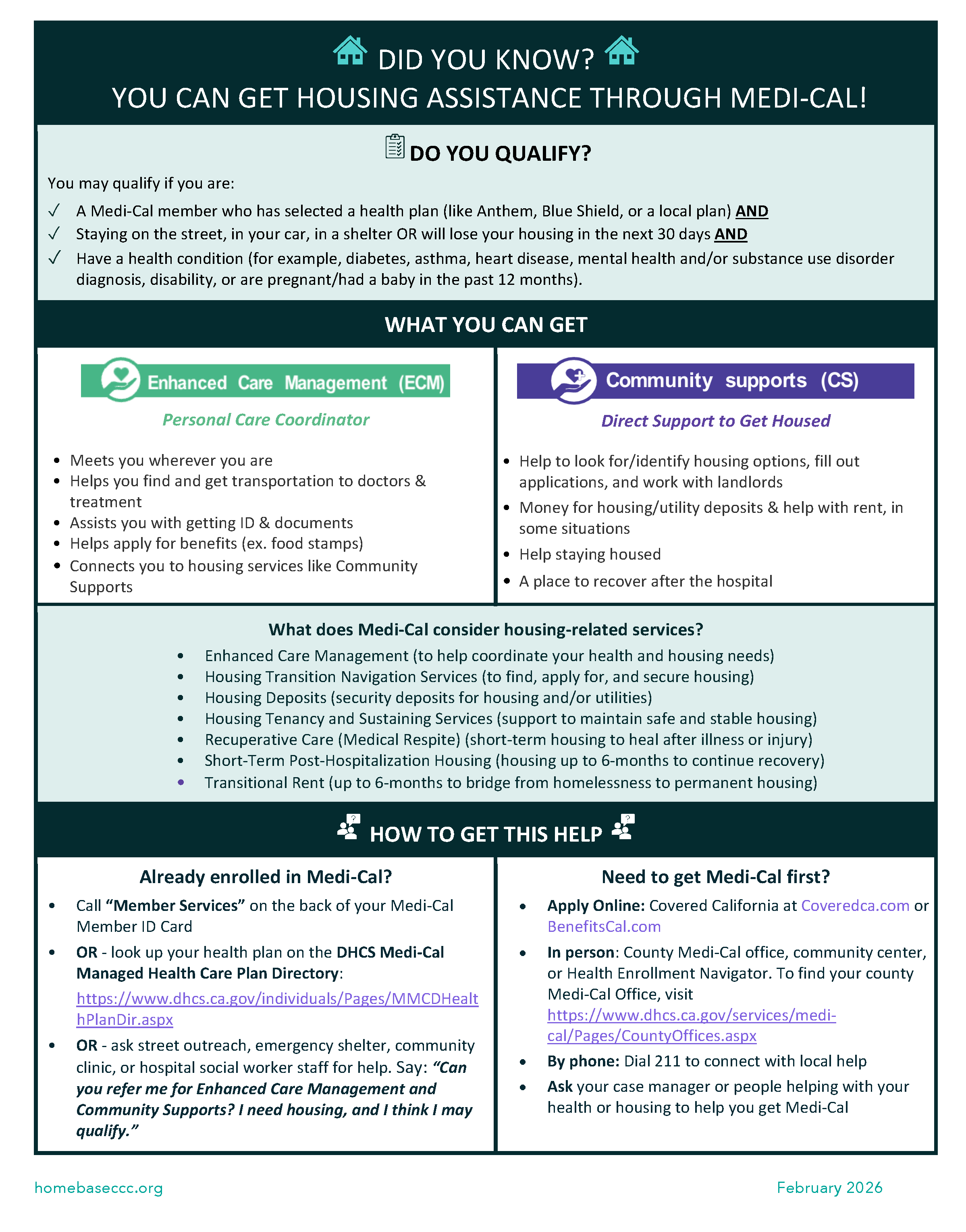
Member Flyer - How to Access Housing Assistance through Medi-Cal: CalAIM's ECM and Community Supports
A one-page flyer for Medi-Cal members experiencing homelessness on how to access housing assistance through Medi-Cal. Able to be distributed electronically or posted at places where Medi-Cal members experiencing homelessness may see it.
Transitional Rent Peer Learning Series
For the first time in California’s history, Medi-Cal (California’s Medicaid program) will provide up to 6 months rental assistance (known as “Transitional Rent”) to members experiencing or at risk of homelessness, to enable them to transition to stable, accessible, and affordable housing. This cross-county peer learning series intended for local implementers goes in-depth on Transitional Rent topics.
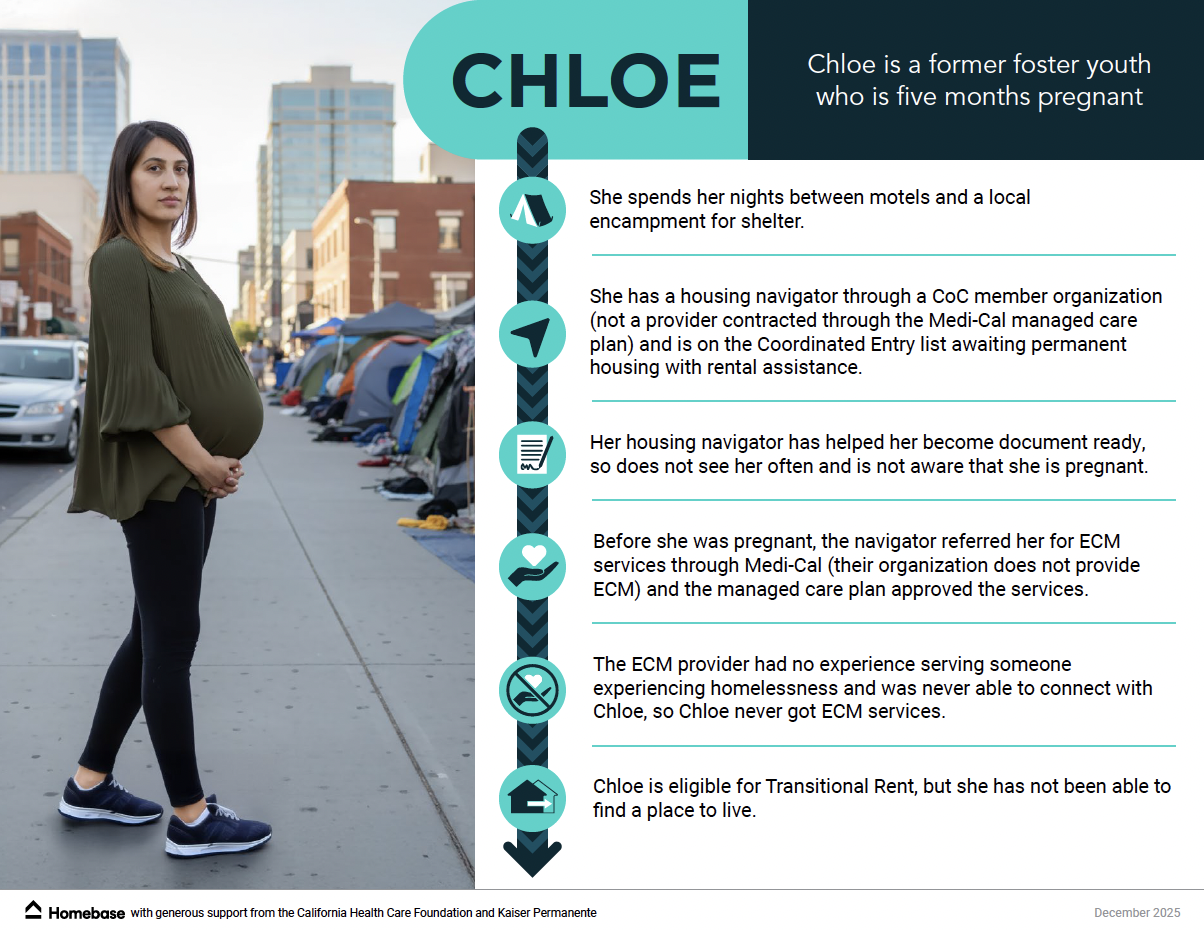
Medi-Cal Member Vignettes
These vignettes illustrate different types of people who may be eligible for Transitional Rent (TR). They are intended to ground TR discussions in the realities of people who may seek this new benefit.
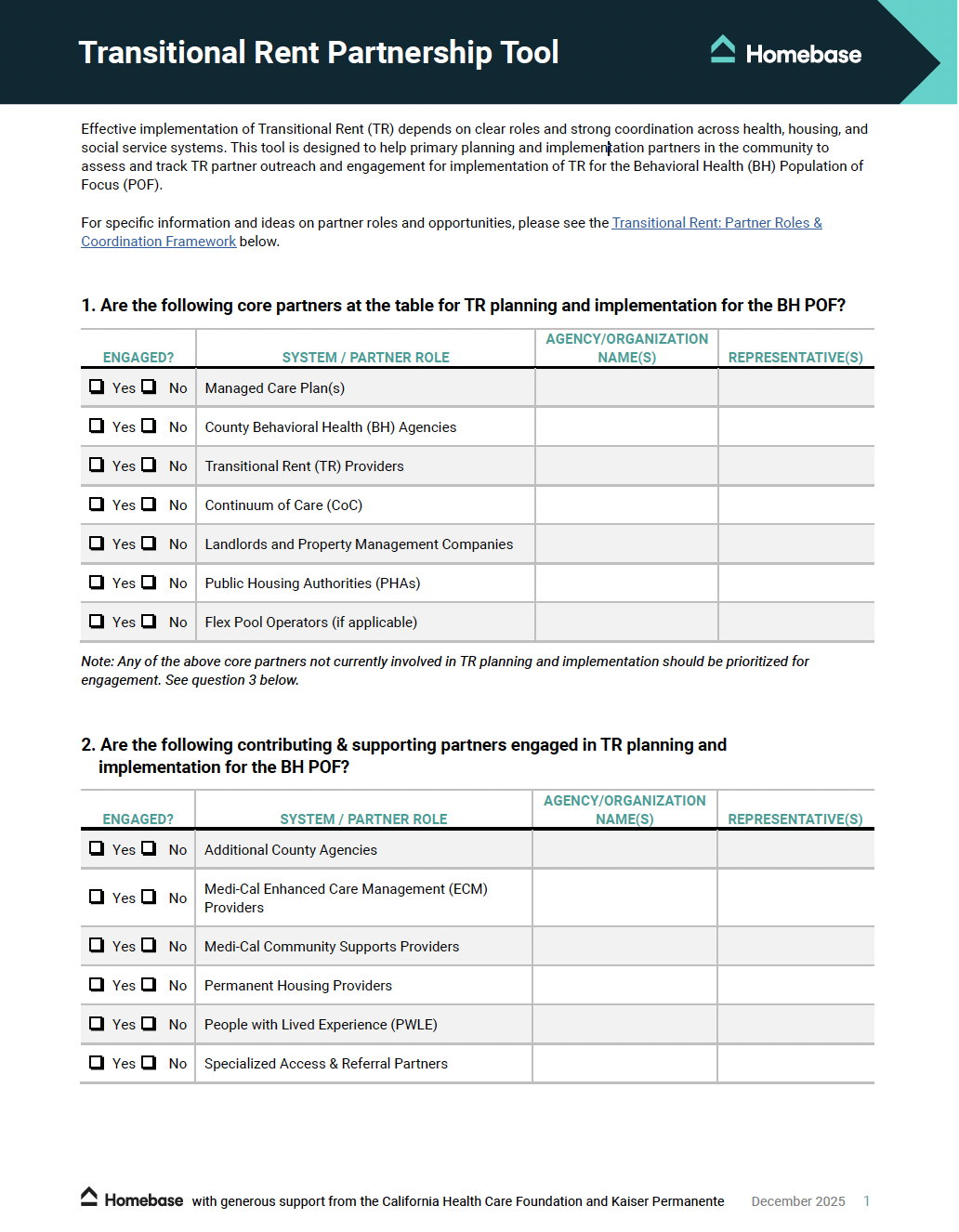
Transitional Rent Partnership Tool
Effective implementation of Transitional Rent (TR) depends on clear roles and strong coordination across health, housing, and social service systems. This tool is designed to help identify and engage TR partners in implementation efforts.

Housing Support Plan (HSP) Template for Transitional Rent and/or Housing Deposits
This document provides a template Housing Support Plan to assist with referrals for Transitional Rent, California's new Medicaid benefit that provides up to six months of rental assistance for eligible Medi-Cal members. Authorization for Transitional Rent requires a completed Housing Support Plan that meets specific criteria.

Transitional Rent Eligibility and Access Guide for the Behavioral Health Population of Focus
This resource provides in-depth details you need about Transitional Rent, who is eligible, and what to do before referring a Member to their managed care plan for Transitional Rent.

Transitional Rent: What to Know Before You Request or Refer
A concise overview of Medi-Cal's new Transitional Rent benefit, who is currently eligible, and what is required to refer someone.
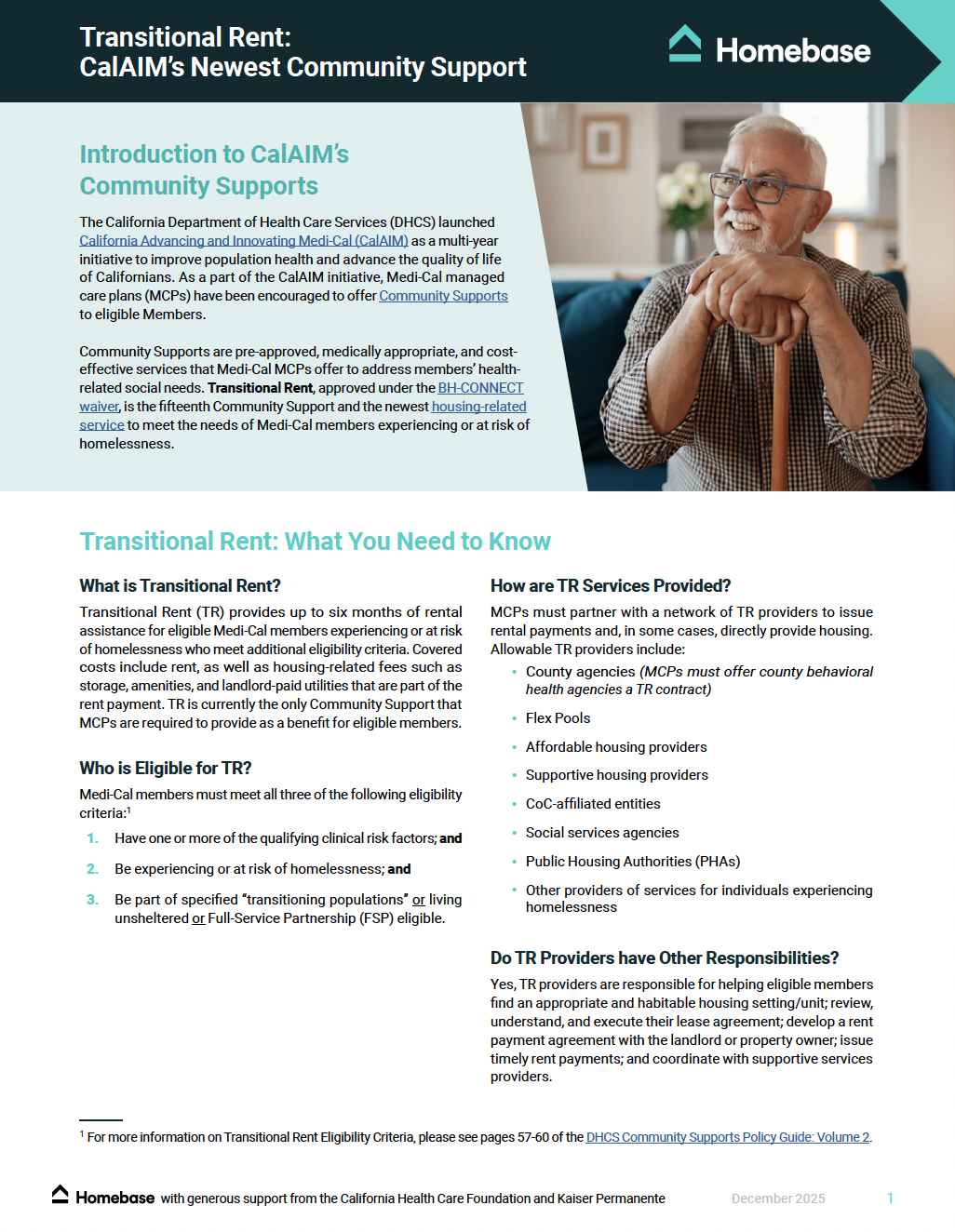
Transitional Rent: CalAIM’s Newest Community Support
A short overview of California's new Medicaid benefit, Transitional Rent, which provides up to six months of rental assistance for eligible Medi-Cal members experiencing or at risk of homelessness who meet additional eligibility criteria.
Transitional Rent Fundamentals for Local Implementers
An overview of California's newest housing-related Medicaid service, Transitional Rent. This webinar is intended primarily for local providers and agencies who are or will be directly involved in Transitional Rent implementation, especially county Behavioral Health departments, managed care plans, homeless response Continuums of Care, and potential Transitional Rent providers.
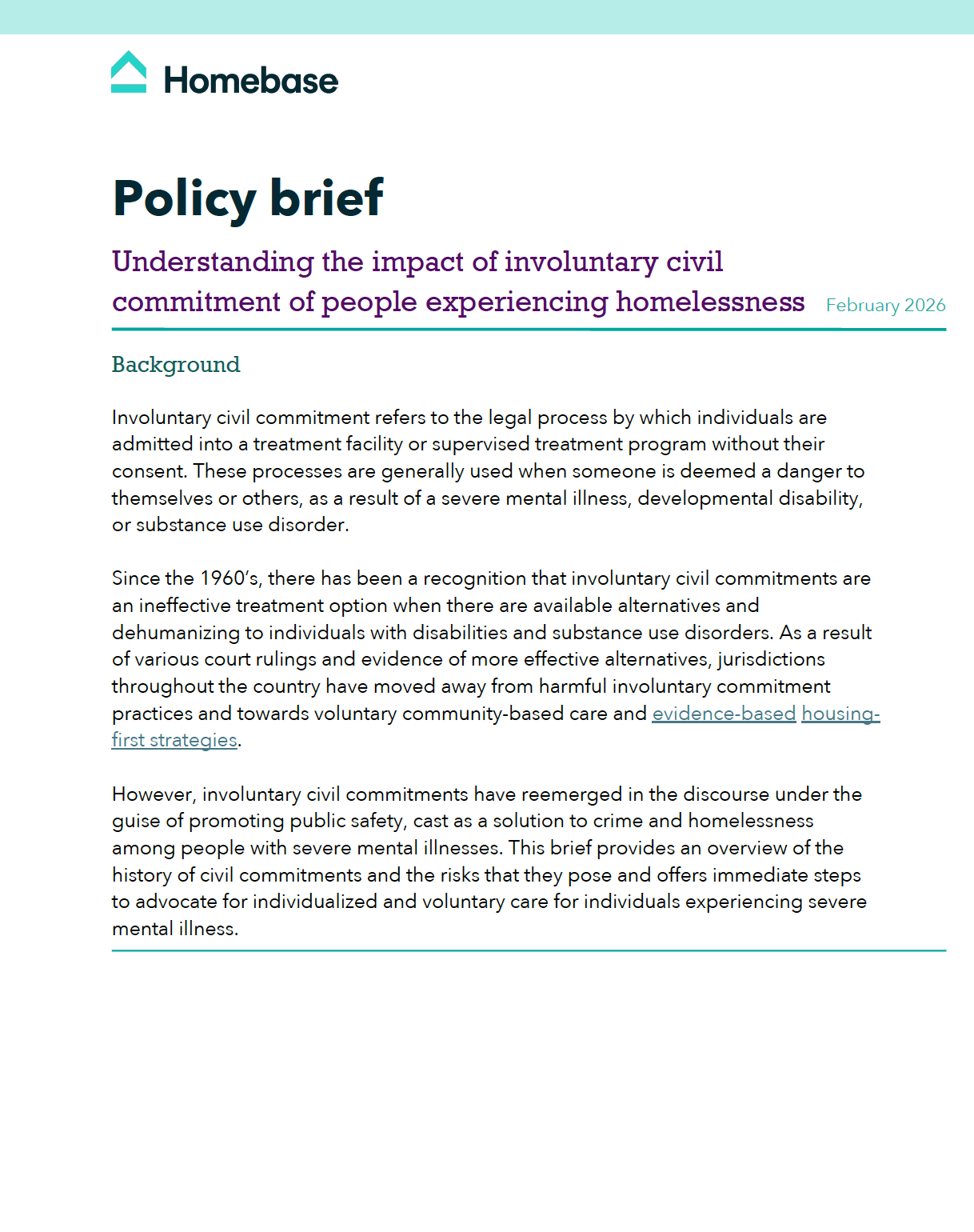
Understanding the impact of involuntary civil commitment of people experiencing homelessness
This brief provides an overview of the history of civil commitments and the risks that they pose and offers immediate steps to advocate for individualized and voluntary care for individuals experiencing severe mental illness.
Transitional Rent Fundamentals for State Agency Staff
This webinar provides an overview of California's newest housing-related Medicaid service, Transitional Rent. Learn the basics of this unprecedented new resource in a digestible way and walk away with a better understanding of the key opportunities ahead.