
Meeting the Housing Needs of People with Criminal Records
A training focused on understanding and reducing housing barriers for people with criminal records.
Strategies for Increasing Client Engagement and Reducing No Shows
This slidedeck presents strategies for increasing client engagement and reducing no shows.
Participatory Continuous Quality Improvement Process Overview
This slidedeck presents the basics on quality improvement as well as a 6-month action plan template.
System Performance Measures Training
This slideck presents an explanation of HUD's System Performance Measures (SPMs) including the kinds of data that impact the SPMs.
Basics of Coordinated Entry
This training is an introductory overview of Coordinated Entry - what it is, how it works, requirements set by HUD, and considerations for successful Coordinated Entry systems.

Financial Management for CoC and ESG Recipients (Mississippi Statewide Training)
This training provides guidance on financial management for CoC and ESG recipients, with a focus on timekeeping and match requirements.
HOME-ARP Eligible Activities
This crosswalk compares key requirements of the HOME-ARP Tenant-Based Rental Assistance (TBRA) activity with Continuum of Care Program (CoC) Rapid Rehousing projects (RRH).
CalAIM Toolkit for Continuums of Care (CoCs) and CoC Partners
The CalAIM Toolkit for Continuums of Care (CoCs) and CoC partners contains guidance and planning documents intended to support effective cross-system collaboration between homeless response system partners and local Medi-Cal managed care plans (MCPs) through the California Advancing and Innovating Medi-Cal (CalAIM) initiative.

Pre-Conviction Housing Preservation
This training is designed to help cross-sector partners gain a basic understanding of relevant housing resources and challenges. It provides an overview of the homelessness response system and covers topics to improve coordination and collaboration across systems. Gain a basic understanding of relevant housing resources and challenges, learn when and how to leverage your clients’ housing status as a form of mitigation, Identify questions to ask your clients that will elicit the information you need, and learn about collaboration opportunities to better defend your clients.
Exploring the Intersection of Homelessness and the Criminal Legal System
This training for cross-sector partners provides an introduction to the homeless system of care and an overview of the practical and legal landscape of the intersection of homelessness and the criminal legal system.

Navigating Housing Choice Voucher (HCV) Program Applications for People with Criminal Records
This resource outlines where PHAs have discretion to provide HCVs to people with criminal records and how to prepare for the HCV application process.

The Fair Housing Act and Criminal Background Checks: What Housing Providers and Case Managers Need to Know
This guide provides an overview of what housing and service providers should know about the Fair Housing Act (FHA) and criminal background checks so that they can comply as housing providers and help ensure the rights of their clients are not violated when they seek housing.
ESG and Indirect Costs Training
An introductory training for Emergency Solutions Grant (ESG) providers on direct, indirect, and adminstrative costs.

Case Managers Roadmap for Housing and Criminal History Information (CHI)
This roadmap offers a high-level overview, key information, and important considerations for case managers as they work to support and collaborate with clients with criminal history information through the housing process.
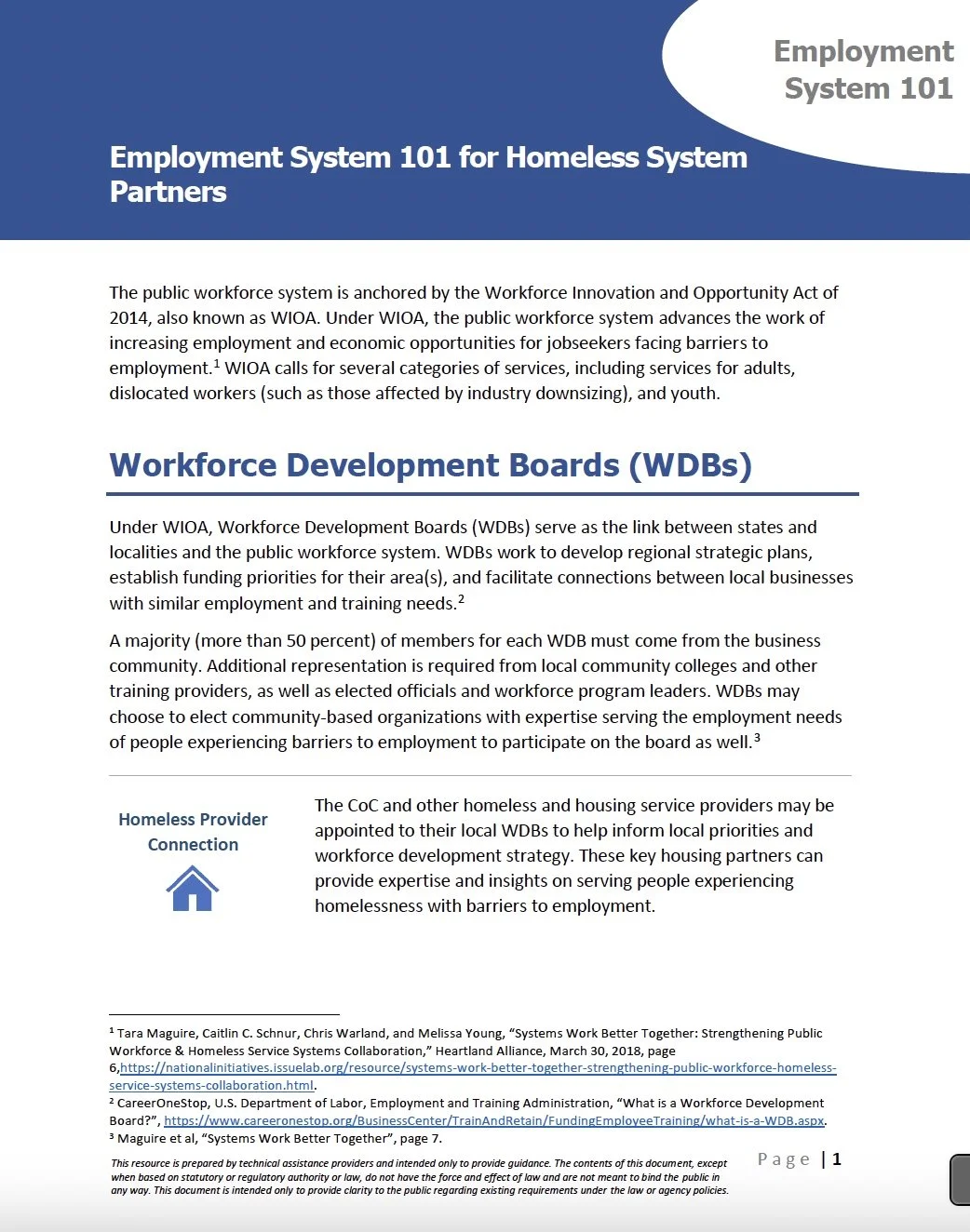
Employment System 101 for Homeless System Partners
The public workforce system is anchored by the Workforce Innovation and Opportunity Act of 2014, also known as WIOA. Under WIOA, the public workforce system advances the work of increasing employment and economic opportunities for jobseekers facing barriers to employment.
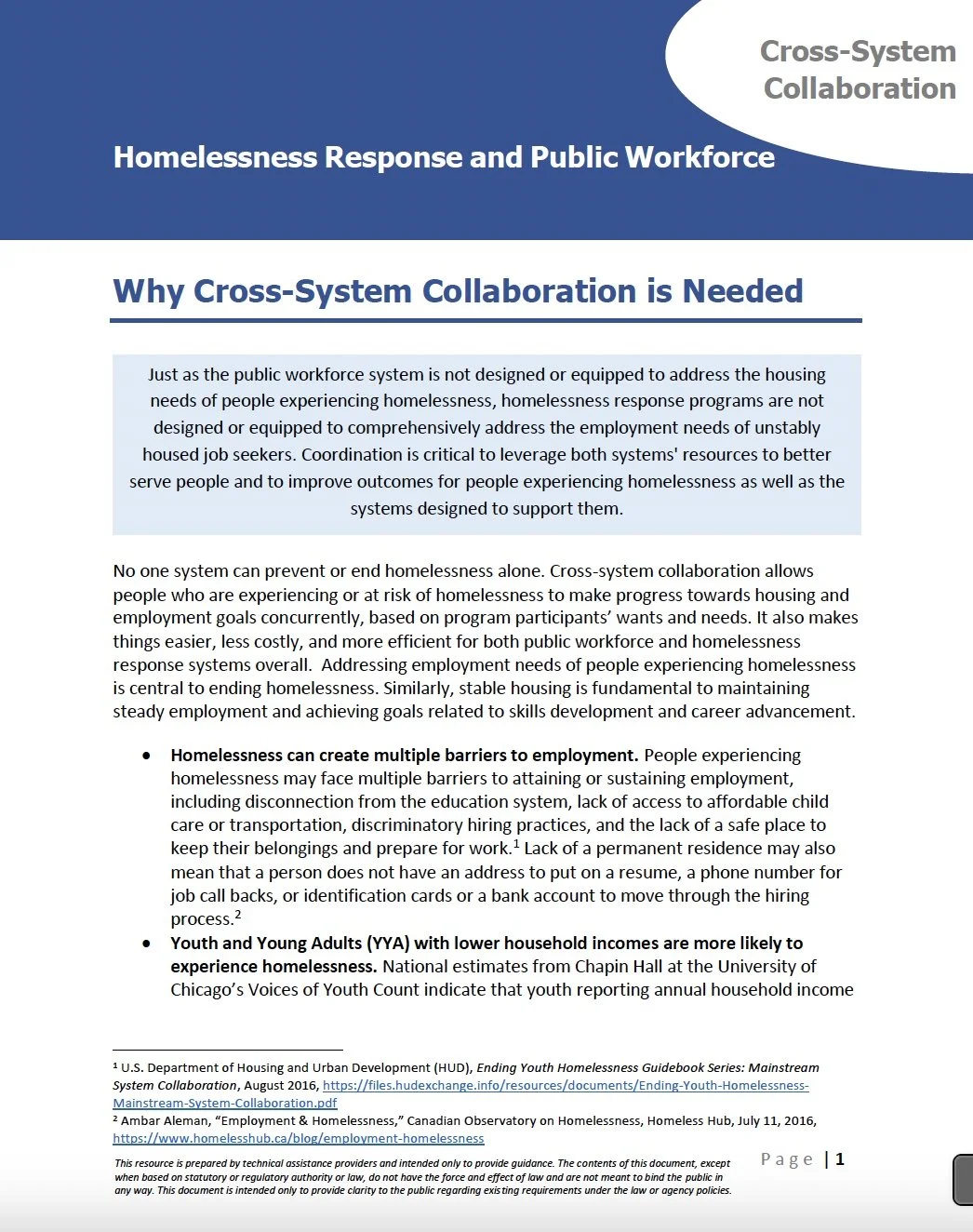
Cross-System Collaboration: Homelessness Response and Public Workforce
Just as the public workforce system is not designed or equipped to address the housing needs of people experiencing homelessness, homelessness response programs are not designed or equipped to comprehensively address the employment needs of unstably housed job seekers. Coordination is critical to leverage both systems' resources to better serve people and to improve outcomes for people experiencing homelessness as well as the systems designed to support them.

Fair Housing Protections for People with Serious Mental Illness, Substance Use Disorder, and Co-Occurring Disorders
People experiencing or at risk of homelessness with mental illness or substance use disorder (SUD) often have a difficult time obtaining housing and may face discrimination because of their conditions. There are federal laws that protect people from this type of discrimination and ensure equal access and opportunity to enjoy housing that suits their needs.
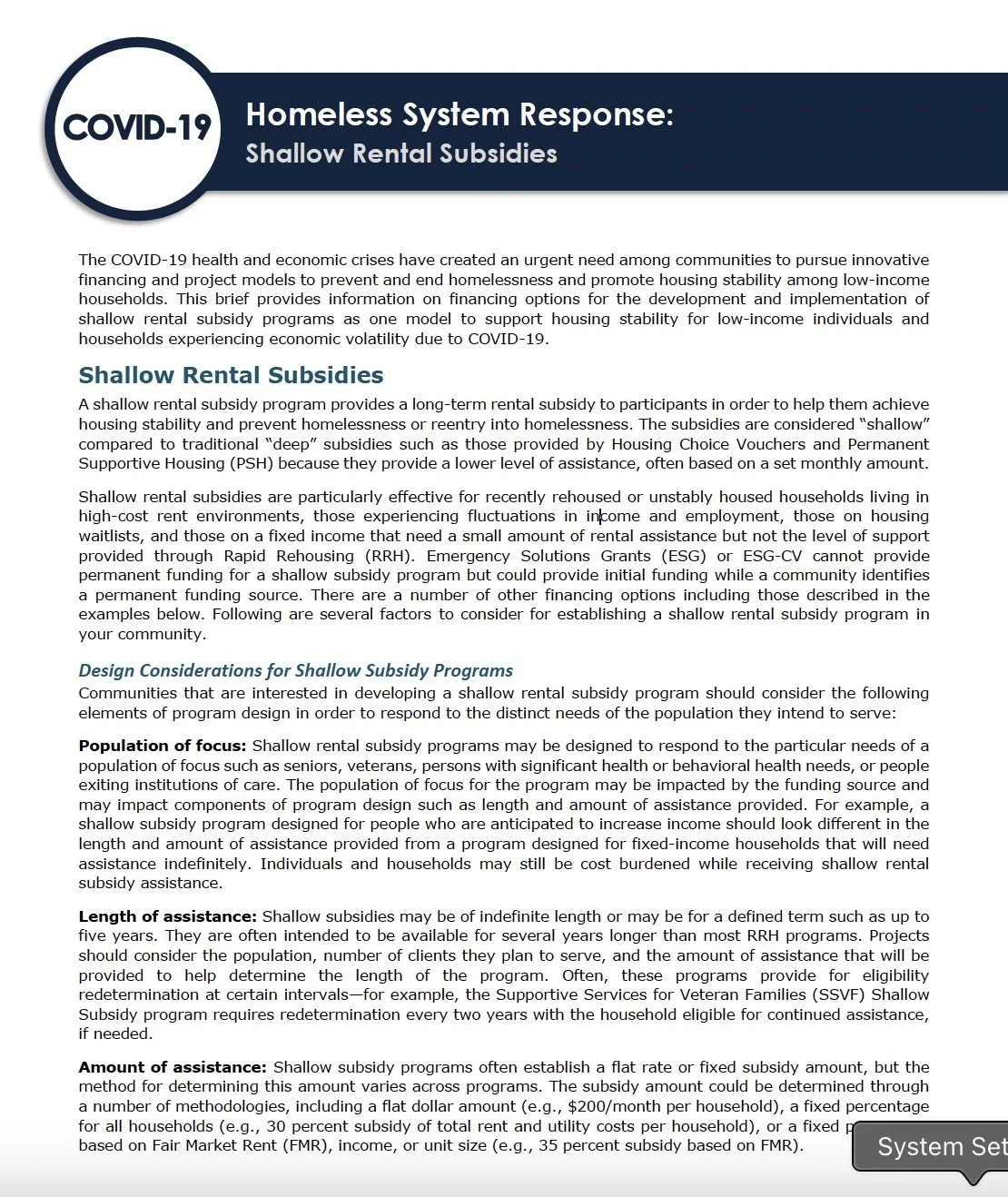
COVID 19 - Homeless System Reponse: Shallow Rental Subsidies
This brief provides information on financing options for the development and implementation of shallow rental subsidy programs as one model to support housing stability for low-income individuals and households experiencing economic volatility.