
10 ways to help people experiencing homelessness keep their Medicaid
This interactive page gives health and housing providers a quick overview of upcoming Medicaid changes and practical steps you can take today. Acting now helps ensure unhoused clients maintain their health coverage and care without interruption.
State Letter about Upcoming Medi-Cal Changes: Help People Experiencing Homelessness Keep Medi-Cal Now
In September 2026, California’s Department of Health Care Services (DHCS) started sending out a four-page letter to Medi-Cal members. The letter went to Medi-Cal members who are part of the ACA Expansion Population (adults 19-64 years old, usually without children). The letter tells members about federal changes to Medi-Cal that go into effect beginning March 1, 2027. The changes include requiring renewals every six months, and requiring members to meet new work and community engagement requirements. Luckily, some members can be excused from the new rules.
Clients who got these letters may start asking questions. The letter may be their first time hearing about the changes to Medi-Cal, and they may need help understanding the new rules. They may need help to not lose Medi-Cal coverage. This document includes useful information for providers to help these clients navigate the changes and maintain coverage.
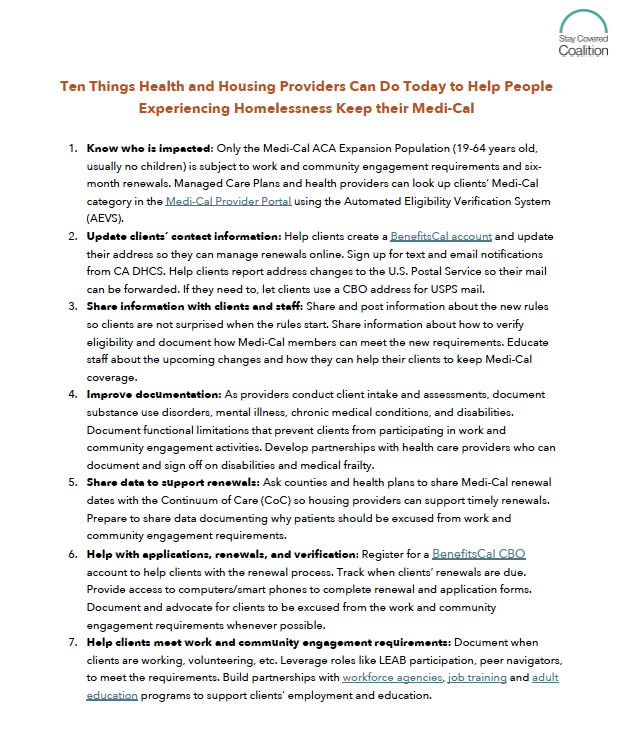
Ten Things Health and Housing Providers Can Do Today to Help People Experiencing Homelessness Keep their Medi-Cal
As 2025 H.R.1 changes put Medicaid coverage at risk, it’s important for health and housing providers to know what they can do to protect coverage for people experiencing homelessness. This document lays out the top ten things providers can do today.
Homelessness by the numbers
In the context of growing misinformation about homelessness, our team wanted to make national data easier to understand.
We started with 2025 Point-in-Time Count (PIT) and Housing Inventory Count (HIC) data shared by the Department of Housing and Urban Development (HUD). These data sets give us a snapshot of people experiencing homelessness and available housing resources in the country.
We analyzed the datasets, highlighted key findings, and created a dynamic site that allows anyone to review national homelessness data in a dynamic, accessible way. We created this site to be an educational tool, especially for people who don’t work in the homelessness system, and to help you tell the story of homelessness in your community. Please share the site!

Self-Pay as a Permanent Housing Solution: Guidance for Agencies Helping Medi-Cal Members Request Transitional Rent
This resource is for individuals and agencies working to help Medi-Cal Members complete Housing Support Plans (HSPs) in support of Transitional Rent (TR) referrals, specifically when the payment source for the Member’s post-TR permanent housing solution is self-pay. It outlines what to include in HSPs to help managed care plans (MCPs) understand a Member’s ability to self-pay as a way to sustain their housing following receipt of TR.
Health and Homelessness Data Sharing Community of Practice
Connecting for Better Health, Homebase, and Georgetown University’s Massive Data Institute have developed the Health and Homelessness Community of Practice (CoP). The CoP brings together Continuums of Care (CoCs), Medi-Cal Managed Care Plans (MCPs), and their partners to address data matching and sharing challenges that prevent people experiencing homelessness from accessing Enhanced Care Management (ECM) and housing-related Community Supports (CS).
Overview of Centers for Medicare & Medicaid Services (CMS) Guidance and Implications
This presentation outlines major Medicaid changes resulting from recently released CMS guidance related to H.R.1, including new work requirements and more frequent eligibility renewals. It also highlights the unique impacts these changes may have on people experiencing homelessness and the homeless response systems that support them.
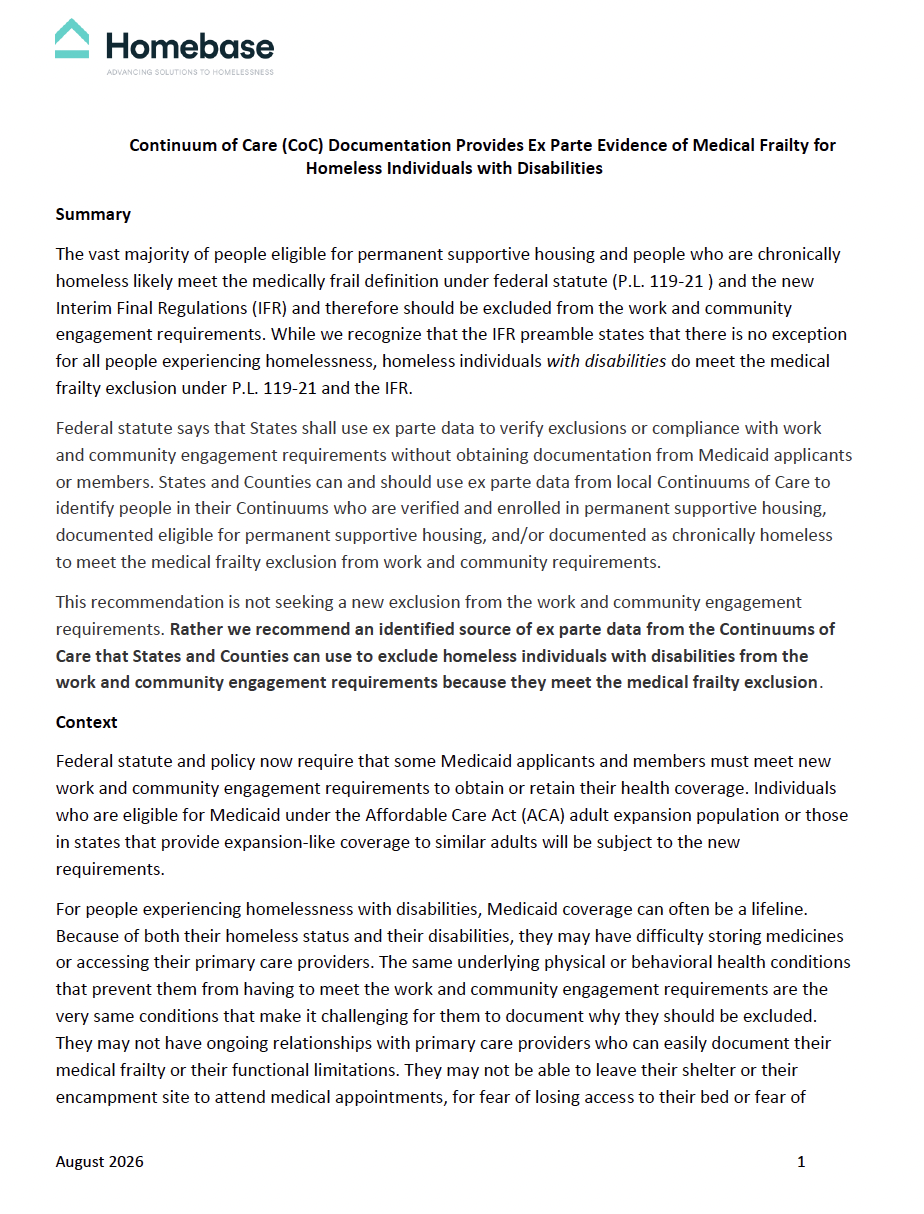
Continuum of Care (CoC) Documentation Provides Ex Parte Evidence of Medical Frailty for Homeless Individuals with Disabilities
Federal statute says that States shall use ex parte data to verify exclusions or compliance with work and community engagement requirements without obtaining documentation from Medicaid applicants or members. States and counties can and should use ex parte data from local Continuums of Care to identify people in their Continuums who are verified and enrolled in permanent supportive housing, documented eligible for permanent supportive housing, and/or documented as chronically homeless to meet the medical frailty exclusion from work and community requirements.
This recommendation is not seeking a new exclusion from the work and community engagement requirements. Rather we recommend an identified source of ex parte data from the Continuums of Care that States and Counties can use to exclude homeless individuals with disabilities from the work and community engagement requirements because they meet the medical frailty exclusion.
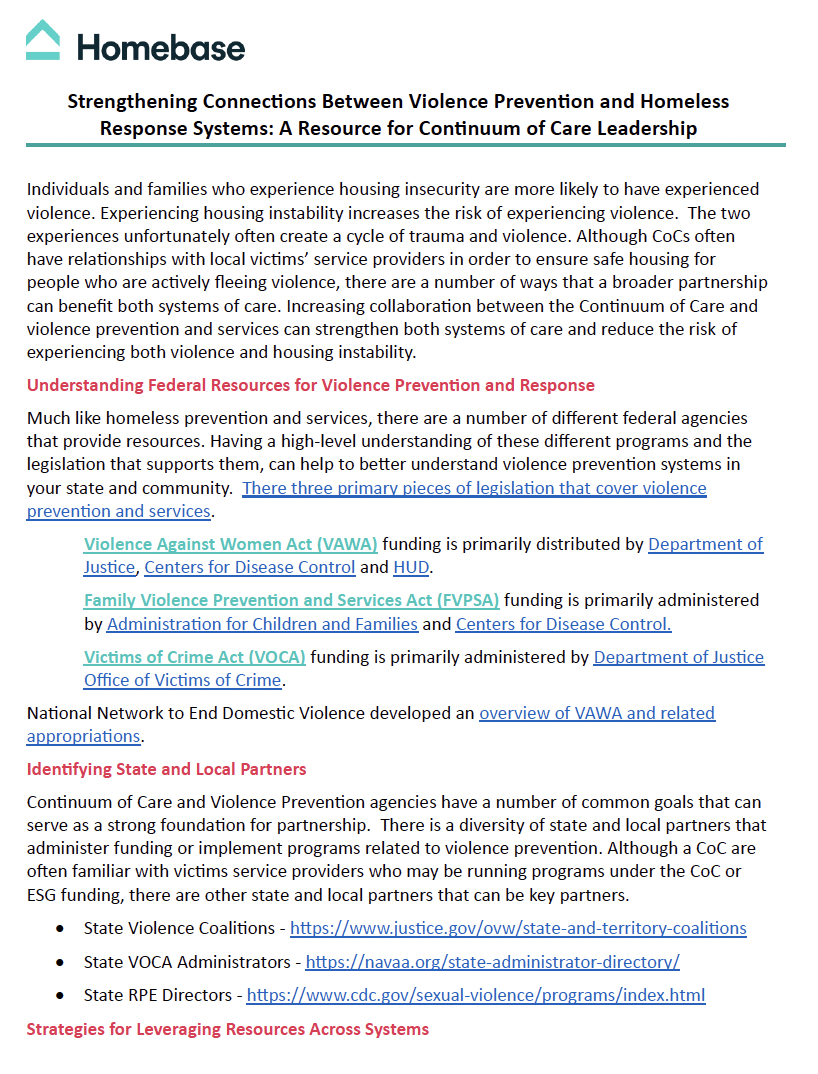
Strengthening Connections Between Violence Prevention and Homeless Response Systems: A Resource for Continuum of Care Leaders
Individuals and families who experience housing insecurity are more likely to have experienced violence, and experiencing housing instability increases the risk of experiencing violence. The two experiences can create a cycle of trauma and violence. Although CoCs often have relationships with local victims’ service providers to ensure safe housing for people who are actively fleeing violence, there are a number of ways that a broader partnership can benefit both systems of care. This resource pulls together guidance and tips for strengthening those partnerships.

Recommendations for Provider Assignments: Improving ECM & Community Supports Implementation
Good matches between Medi-Cal members experiencing homelessness and Enhanced Care Management (ECM) and housing-related Community Supports providers are vital to ensure members are successfully engaged, enrolled, and utilizing these critical resources. This resource includes tips and data sources to help managed care plans match members experiencing homelessness to providers best positioned to support them. It covers initial provider assignments and provider switching.

Meeting People Where They Are: A Guide for ECM Providers Serving People Experiencing Homelessness
Meeting people where they are is a core principle of Enhanced Care Management (ECM), but delivering services in shelters, encampments, and other community settings requires thoughtful planning and support. This resource shares practical strategies to help any ECM provider engage people experiencing homelessness in the field, with considerations for how Medi-Cal Managed Care Plans can support.
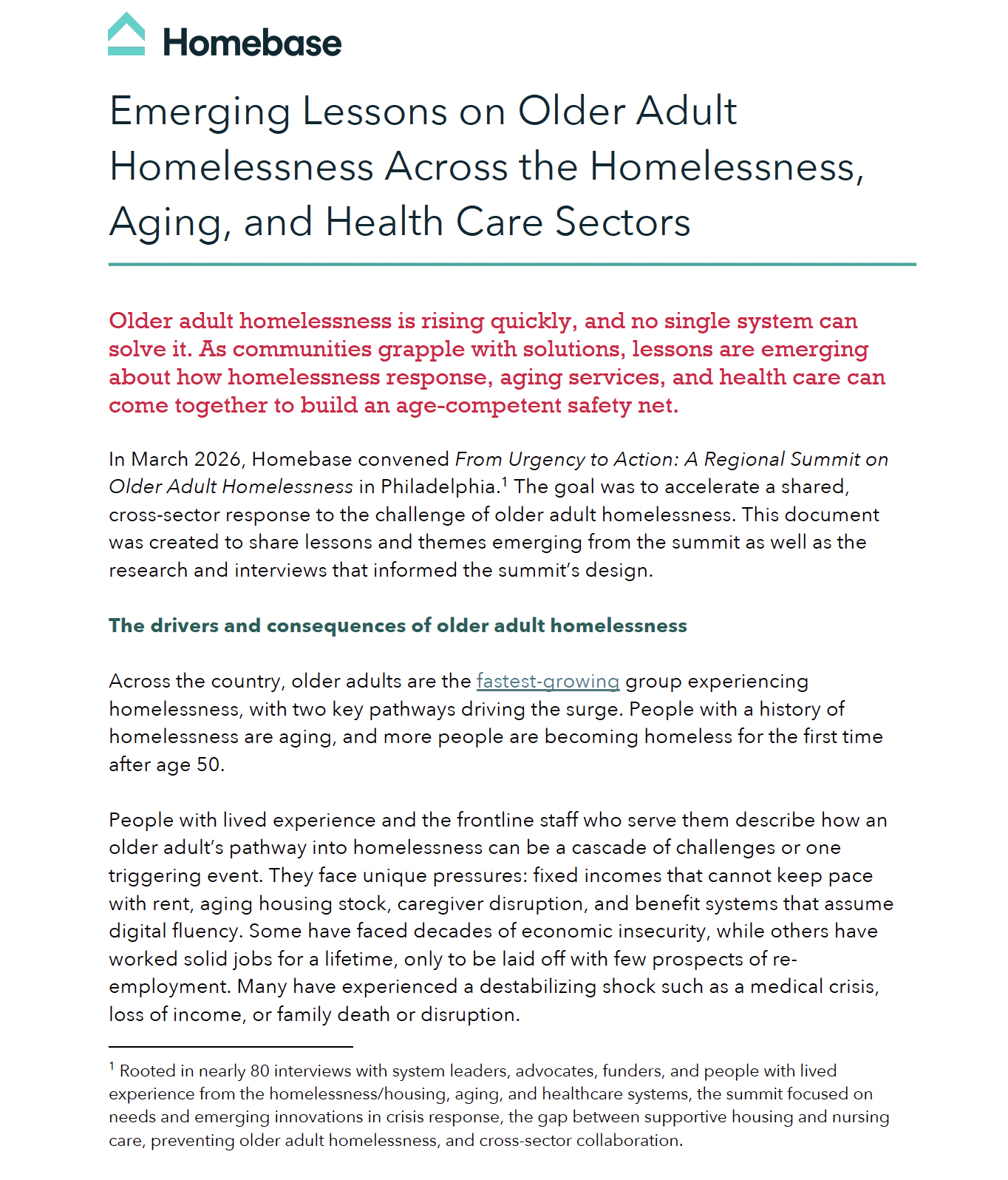
Cross-Sector Lessons to Address Older Adult Homelessness
Older adult homelessness is rising quickly, and no single system can solve it. As communities grapple with solutions, lessons are emerging about how homelessness response, aging services, and health care can come together to build an age-competent safety net.
In March 2026, Homebase convened From Urgency to Action: A Regional Summit on Older Adult Homelessness in Philadelphia. The goal was to accelerate a shared, cross-sector response to the challenge of older adult homelessness. This document was created to share lessons and themes emerging from the summit as well as the research and interviews that informed the summit’s design.
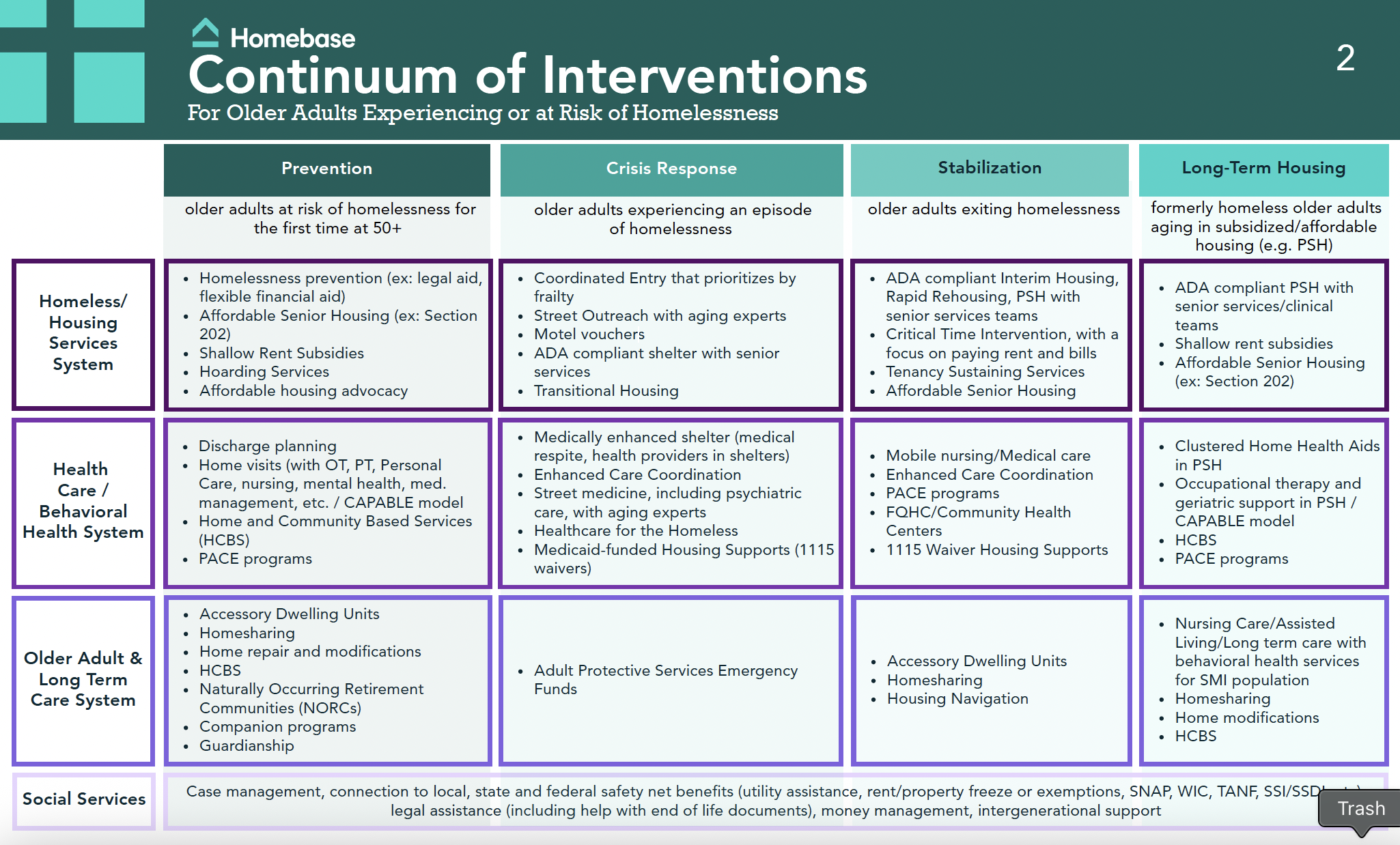
Continuum of Interventions for Older Adults Experiencing or at Risk of Homelessness
Homebase created this Continuum of Interventions for Older Adults Experiencing or at Risk of Homelessness based on research and conversations with people with lived experience of homelessness, practitioners, policy makers, funders, and other experts, and with input from attendees of From Urgency to Action: A Regional Summit on Older Adult Homelessness, held in March of 2026. Thank you to all who contributed!
The Continuum outlines the ways that older adults may intersect with housing instability and homelessness and the types of interventions that key sectors can deploy to improve outcomes for older adults, depending on the specific setting, population, and needs.
5 Key Takeaways from Homebase’s Summit on Older Adult Homelessness
On March 24th, Homebase held From Urgency to Action, Homebase’s first summit on the topic of older adult homelessness. Throughout the day, we heard from providers, government agencies, and people with lived experience of homelessness in the Mid-Atlantic region, who have touched this issue in some way. Over the course of the day’s panel presentations and group discussions, Homebase team member Garen Nigon developed a few takeaways, five of which are shared here.

In Their Own Words - Californians' Journeys From Encampments to Housing
This report explores how four California communities are implementing encampment resolution efforts, and how those strategies are experienced by residents, drawing on interviews, HMIS data, and policy review. It identifies promising practices, persistent barriers, and key themes that shape pathways to permanent housing. Funded by the National Alliance to End Homelessness (NAEH), the study offers practical insights for designing more humane and effective responses to unsheltered homelessness.
Independence, Dignity, and Community: How occupational therapy helps to keep older adults housed
A conversation with Robin Kahan-Berman, Vice President of Occupational Therapy at Project Renewal, a New York City-based nonprofit that provides housing, health care, and employment opportunities to New Yorkers who have experienced homelessness. The organization is on the leading edge of incorporating occupational therapy (OT) across its shelters and housing programs, including its Helping Older People Engage (HOPE) initiative. In this condensed interview, she explains the power of OT to increase the chances that clients stay housed even as they encounter the health and cognitive challenges associated with aging – and the journey to build and sustain such a substantial OT practice within the homelessness sector.
Targeted Homelessness Prevention Webinars
In partnership with Right at Home, Homebase is building a national network of experts to deepen the impact of homelessness prevention as a crucial intervention in homelessness response. These community meetings are a part of that effort.
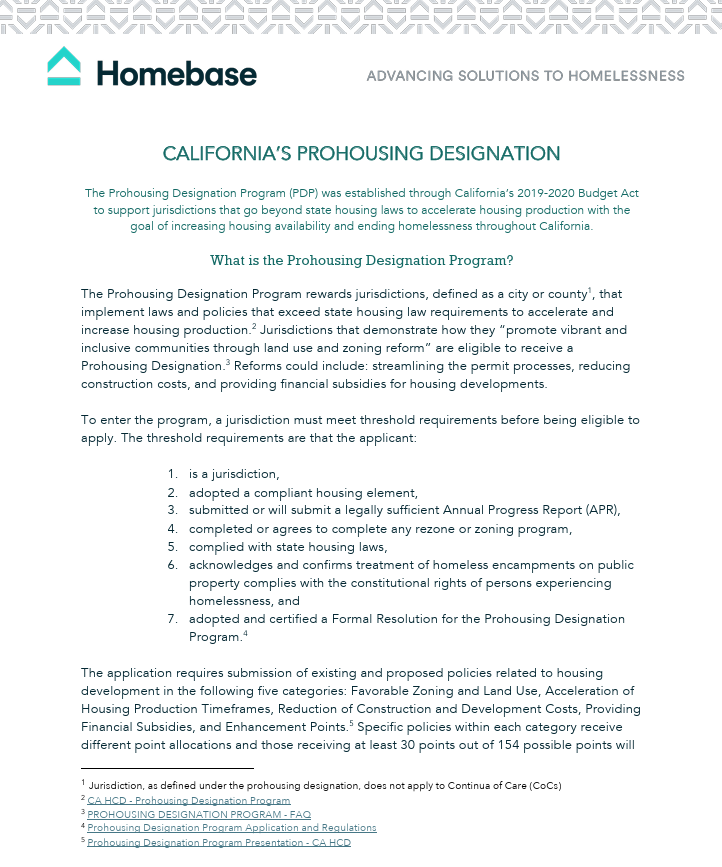
Factsheet on California’s Prohousing Designation
The Prohousing Designation Program (PDP) was established through California’s 2019-2020 Budget Act to support jurisdictions that go beyond state housing laws to accelerate housing production with the goal of increasing housing availability and ending homelessness in California. This document provides an overview of the PDP, implications on state funding allocations, and recommendations for jurisdictions considering an application.
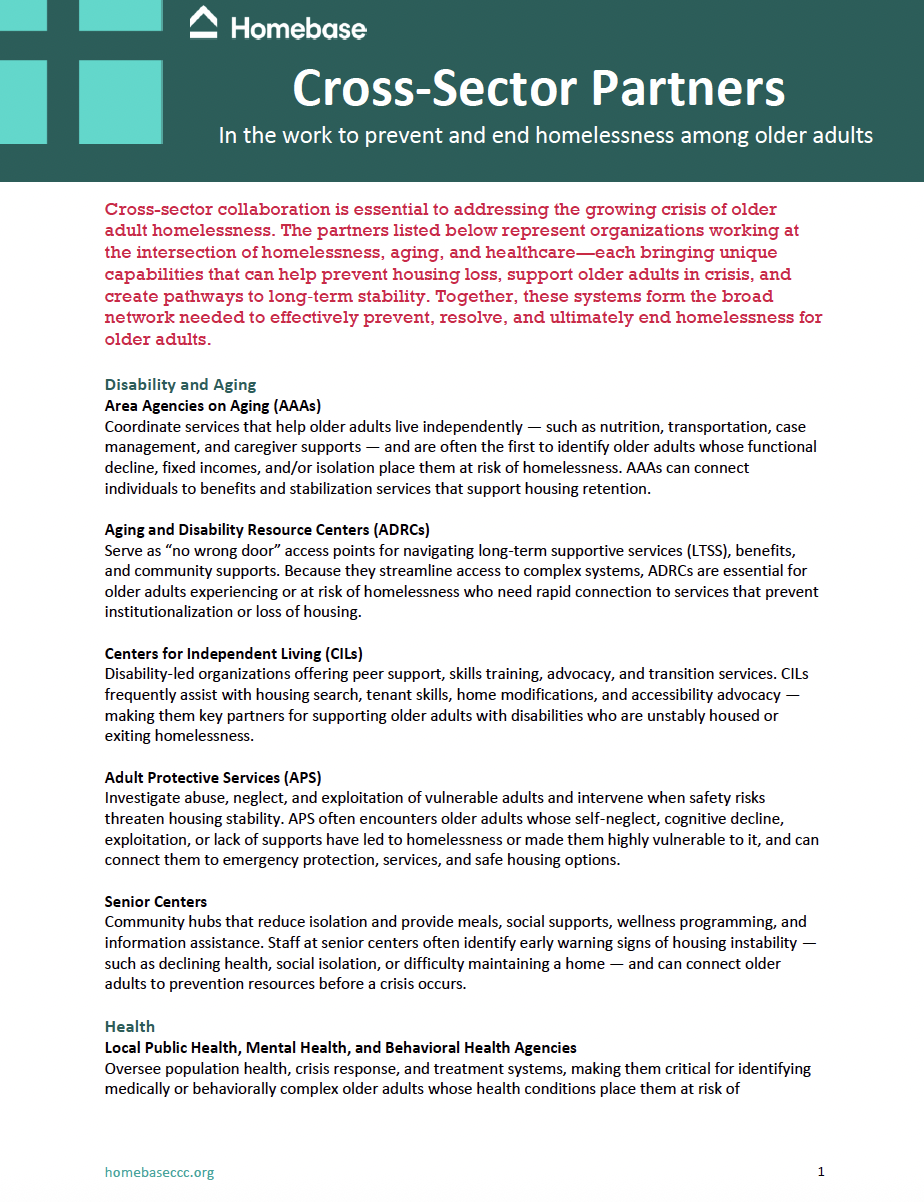
Cross Sector Partners in the Work to Prevent and End Homelessness Among Older Adults
Cross-sector collaboration is essential to addressing the growing crisis of older adult homelessness. The partners listed in this document represent organizations working at the intersection of homelessness, aging, and healthcare—each bringing unique capabilities that can help prevent housing loss, support older adults in crisis, and create pathways to long‑term stability. Together, these systems form the broad network needed to effectively prevent, resolve, and ultimately end homelessness for older adults.
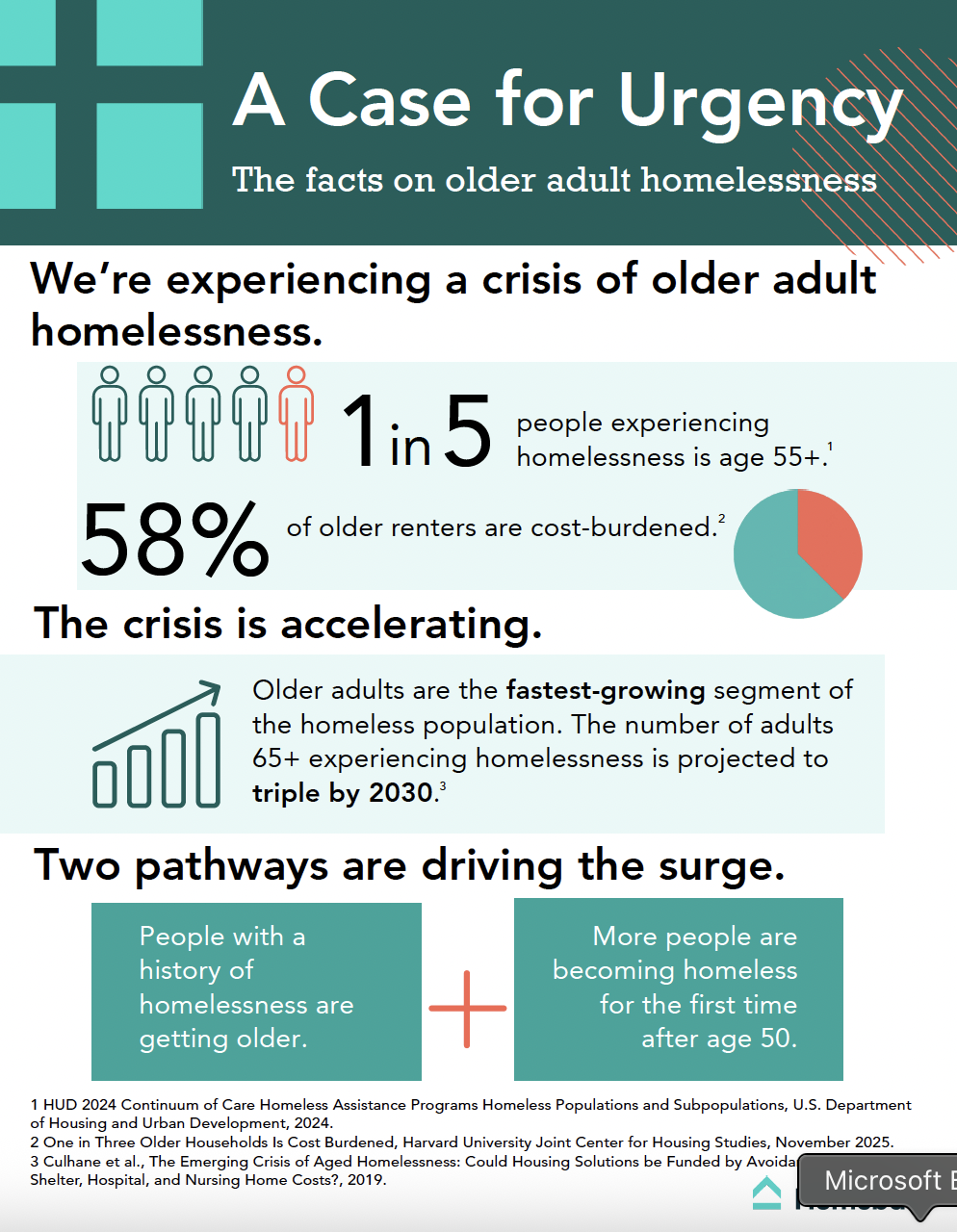
A Case for Urgency: the facts on older adult homelessness
This factsheet provides an overview of what the numbers are saying about the growing crisis of older adult homelessness in the U.S. It is intended to serve as a starting point for conversations between systems - including homelessness response, health care, and aging - and to underscore the need for alignment across systems to address the unique needs of this population.